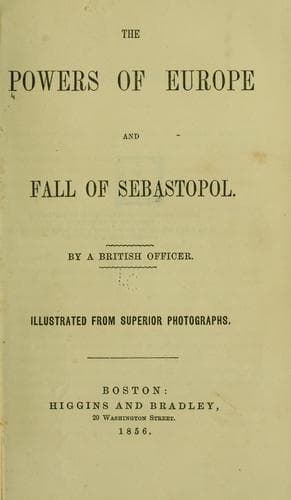
The Powers of Europe and Fall of SebastopolA British officer
History
The Powers of Europe and Fall of Sebastopol
A British officer
Crimean War, 1853-1856; Europe -- History -- 1789-1900
From that day he applied himself to improving the efficiency of his
army, paying attention not only to the discipline, but also to the
education, of the soldier. The Mussulman, good and meek-hearted by
nature, never ferocious but in individual cases, was raised by him to
the self-consciousness of human dignity, by regulations, ordinances,
and laws, calculated to make him cognisant of the rights, and
conversant with the duties that belong to every one, in every state
of life. Self-esteem--a feeling that, being once awakened from a long
lethargy, soon endears itself to every man--discipline, and Omer’s
benevolent disposition even towards the lowest of his soldiers,
caused him to be loved by them more as a father than as a general.
After Mahmud’s decease, his expeditions continued under the
new Sultan. In Albania, in Bosnia once more, in Syria, in the
Kurdistan, among the wild tribes of the Ravendus, Romelia, in
the Moldo-Wallachian Principalities, and in Montenegro, he was
distinguished in both a military and civil capacity. Having adopted
Turkey as a second country, he loved and loves her, not as a warrior
merely, but as the member of a family which powerful enemies are
attempting to disorganize and destroy. Before fighting, he always
tried to conciliate; compelled to employ force, he never abused
victory, to assuage either the resentment or the cupidity of his
troops.
In a work so difficult as the regeneration of an entire nation, he
had many fellow-laborers. Amongst them the first undoubtedly was an
eminent man, whose talents as a diplomatist London and Paris have had
occasion to notice, and whom they have since been able to appreciate
as a statesman: we mean Reschid Pacha. We call him a companion, and
not the chief of the enterprise; for Reschid Pacha, indeed, tried to
transplant European civilization to the empire, though by measures
which would have had no immediate utility without the activity of
Omer Pacha.
In the midst of many labors, he ran through all the degrees of
the army, till he obtained the rank of the highest in the Ottoman
service. Invested with the great decoration of the Nichani-Iftikhar
by Sultan Mahmud; with that of the Mejidiè[4] by Sultan Abdul
Medjid; and, lastly, presented at Shumla with a sword of honor, he
could not avoid making bitter enemies. Old Turkey was continually
watching him with envious rancor; but he shrewdly flattered its
apostles when he thought it proper for his purpose; overpowered them
with generosity, when an exchange of hostilities would have injured
his cause; and openly set them at defiance when dissembling would
have been weakness, and silence an act of cowardice.
Public-domain text, read in full here on John Shaqi.
Reviews
Reviews
No reviews yet
Be the first to share your thoughts on this work.
Elsewhere in the archive
Join the Discussion
Join the discussion
Sign in to leave a comment or review.
Sign InorCreate an account