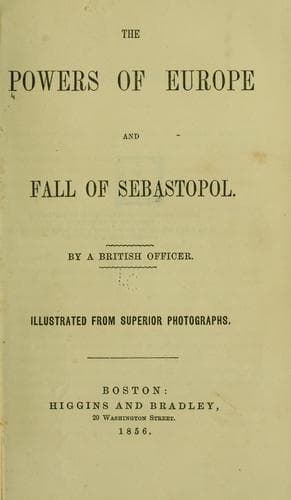
The Powers of Europe and Fall of SebastopolA British officer
History
The Powers of Europe and Fall of Sebastopol
A British officer
Crimean War, 1853-1856; Europe -- History -- 1789-1900
Engaged in all the struggles of the two parties during the most
important period of their existence, the principal instrument of
progress and of Young Turkey, he always regretted the necessity of
drawing the sword against his fellow-subjects. It was farthest from
his wish to tinge it with blood, even to impose what was, if not
the common desire, the common advantage, namely, the improvement of
society in all its developments. But of these ill-omened seditions,
Turkish subjects were the arms, while the head was invisible, and
kept itself in security from his blows, beyond the frontiers.
Often, even far from the noise of arms, he baffled the plots of the
insidious enemies of Turkey. The most enviable of his bloodless
victories was the cause of Kossuth and the Hungarian refugees, whom
he met at Shumla, whither he had purposely repaired. He espoused
their cause before the Sultan and the ministers of the Porte. The
Sultan’s sentiments regarding them were not less noble than his
own; but his protection had for its object to neutralize the effect
of foreign threats, lest, by the Sultan’s yielding to them, the
cause of progress should be deprived of the most valuable accession
of material and intellectual forces which the new-comers might
confer on it. His wishes, owing especially to the intervention of
the English fleet, were crowned with success, and he succeeded in
taking many of them under his command. The immigration, indeed, of
Italians, Hungarians, and Poles, has been no inconsiderable help to
the progress of Turkey in late years. The popular sentiment hailed
them, because they were the enemies of its enemies; and the accession
of elements so free, so ardent, and enthusiastic for the cause
that drew them to exile, added an immense and rapid impetus to the
reform party. They caused no little uneasiness to Russia and Austria,
who, in every negotiation with Turkey, even in the last question,
always insisted on the banishment of the political refugees to Asia.
Russia fears only civilized men, and therefore she must be met by
civilization dressed up in its full armor. Turkish civilization would
give her the greatest annoyance: not to thwart it by every possible
means would be an eternal remorse; and not to succeed in crushing it
in the bud would be followed by the bitterest regrets.
The internal contest has now disappeared before the external, and
Omer Pacha beholds united under his banner both old and young Turkey.
Public-domain text, read in full here on John Shaqi.
Reviews
Reviews
No reviews yet
Be the first to share your thoughts on this work.
Elsewhere in the archive
Join the Discussion
Join the discussion
Sign in to leave a comment or review.
Sign InorCreate an account