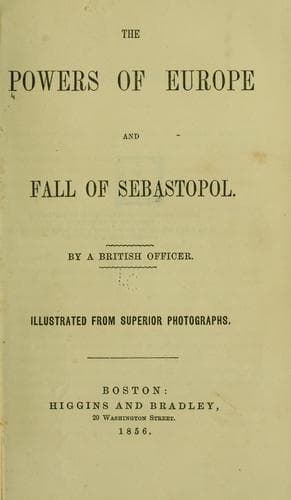
The Powers of Europe and Fall of SebastopolA British officer
History
The Powers of Europe and Fall of Sebastopol
A British officer
Crimean War, 1853-1856; Europe -- History -- 1789-1900
Turkey thus at once resumed her position as a military power, and
gave earnest, that when the ten or twelve millions, constituting her
Christian population, shall have accepted the offer of the Sultan
to bear arms like their Mahometan fellow-subjects, she will be in a
position to protect herself against any aggression. Time of course
must elapse before this takes place; but enough has been done to
prove that the protection of England and France need not be always
indispensable to the existence of the Turkish empire.
It is unnecessary for our present purpose to follow the hostile
armies on the Danube through all their operations. It will be
sufficient to observe, that after the various engagements in the
neighborhood of Kalafat, Omer Pacha resumed the plan on which he
had previously proceeded at Giurgevo and Oltenitza, the object of
which was to constrain the Russians to detach a portion of their army
in order to cover Bucharest. He had no desire to attempt any rash
enterprise, but prudently kept watch, so as to avail himself of any
favorable contingency; his character presenting a happy combination
of daring and prudence.
While the events we have related were proceeding, the war was
being carried on with vigor on the frontier of Asia: numerous
conflicts took place, attended with much slaughter, but not with any
very commensurate results. The most important battle was that of
Akhaltzik, claimed by the Russian General, Prince Andronikoff, as a
great victory. Like that of Sinope, it was celebrated at Petersburg
by a solemn _Te Deum_; “The most pious Czar,” in the words of the
Government organ, “thanking the Lord of lords for the success of the
Russian arms in the sacred combat for the orthodox faith.” (!)
The allied squadron in the Black Sea, after having escorted a
Turkish squadron freighted with supplies to Batoum, Trebizonde,
and Checkvetil, reconnoitred the Russian fleet in Sebastopol, and
returned to the Bosphorus.
England and France having announced to the world their intention
of affording to Turkey both moral and material support, but their
_moral_ aid having failed to avert the invasion of the Danubian
provinces, the massacre of Sinope, or the treachery of Austria,
masked as it was under the guise of friendship, it became incumbent
on the two Western Powers to abandon at once all further discussion,
and to appeal to the stern but inevitable arbitrament of the sword.
The Queen’s declaration of war appeared in the Gazette of the 28th
of March: on the preceding day, at Paris, the Minister of State read
to the Legislative corps a message from the Emperor, announcing
“that the last resolution of the Cabinet of St. Petersburg had
placed Russia in a state of war with respect to France--a war, the
responsibility of which belonged entirely to the Russian Government.”
Public-domain text, read in full here on John Shaqi.
Reviews
Reviews
No reviews yet
Be the first to share your thoughts on this work.
Elsewhere in the archive
Join the Discussion
Join the discussion
Sign in to leave a comment or review.
Sign InorCreate an account