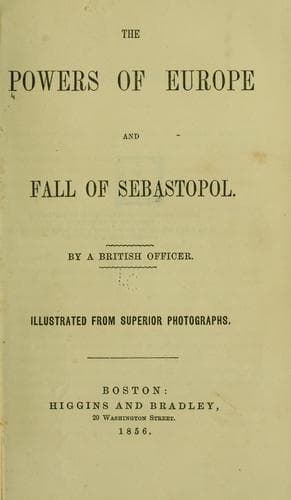
The Powers of Europe and Fall of SebastopolA British officer
History
The Powers of Europe and Fall of Sebastopol
A British officer
Crimean War, 1853-1856; Europe -- History -- 1789-1900
On the morning of the 20th, ere daybreak, the whole force was under
arms. They were marshalled silently; no bugles or drums broke the
stillness; but the hum of thousands of voices rose loudly from
the ranks, and the watchfires lighted up the lines of the camp as
though it were a great town. When dawn broke it was discovered that
the Russians had retired from the heights. It was known that the
Russians had been busy fortifying the heights over the valley through
which runs the little river Alma, and that they had resolved to
try their strength with the allied army in a position giving them
vast advantages of ground, which they had used every means in their
power to improve to the utmost. The advance of the armies this great
day was a sight which must ever stand out like the landmark of the
spectator’s life. Early in the morning, the troops were ordered to
get in readiness, and at half-past six o’clock they were in motion.
It was a lovely day; the heat of the sun was tempered by a sea
breeze. The fleet was visible at a distance of four miles, covering
the ocean as it was seen between the hills, and steamers could be
seen as close to the shore as possible. The Generals, St. Arnaud,
Bosquet, and Forey, attended by their staff, rode along the lines,
with Lord Raglan and his Generals at second halt, and were received
with tremendous cheering.
The order in which the army advanced was in columns of brigades in
deploying distance; the left protected by a line of skirmishers of
cavalry and of horse artillery. The advantage of the formation was,
that the army, in case of a strong attack from cavalry and infantry
on the left or rear, could assume the form of a hollow square, with
the baggage in the centre. The great object was to gain the right of
the position, so that the attacking parties could be sheltered by the
vertical fire of the fleets. As soon as the position of the allies
could be accurately ascertained, the whole line, extending itself
across the champaign country for some five or six miles, advanced. At
the distance of two miles the English army halted to obtain a little
time to gather up the rear; and then the troops steadily advanced in
grand lines, like the waves of the ocean.
The French occupied the high road, nearest the beach, with the Turks;
and the English marched to the left. At about one o’clock in the
afternoon, the Light Division of the French army came in sight of the
village of Almatamak, and the British Light Division descried that of
Burliuk, both situated on the right bank of the river Alma.
Public-domain text, read in full here on John Shaqi.
Reviews
Reviews
No reviews yet
Be the first to share your thoughts on this work.
Elsewhere in the archive
Join the Discussion
Join the discussion
Sign in to leave a comment or review.
Sign InorCreate an account