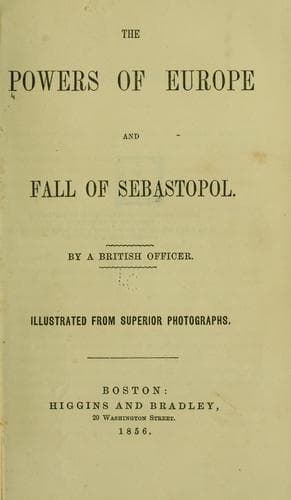
The Powers of Europe and Fall of SebastopolA British officer
History
The Powers of Europe and Fall of Sebastopol
A British officer
Crimean War, 1853-1856; Europe -- History -- 1789-1900
It was in 1848, however, that Colonel Canrobert displayed energies
beyond all praise. Cholera was raging in the garrison of Aumale,
but the events which were passing at Zaatcha summoned them before
the walls of this oasis. What courage and coolness did it require
in the commander of the Zouaves to lead his soldiers in this manner
through all the perils of an adventurous march; soldiers constantly
accompanied by the afflicting spectacle of misery. He, as it were,
multiplied himself. He exhorted the sick, devoted himself to them;
threw a reinforcement into the town of Bon Sada, the garrison of
which was blockaded; deceived the enemy, who opposed his passage, by
announcing that he brought pestilence with him, and that he should
communicate it to his assailants. On the 26th he led, with wondrous
intrepidity, one of the attacking columns--but of four officers
and sixteen soldiers who followed him to the breach, sixteen were
killed or wounded at his side. In recompense for his conduct he was
nominated Commander of the Legion of Honor on the 11th of December,
1849.
Having distinguished himself at the battle of Narah, he was elevated
to the rank of general of brigade on the 13th of January, 1852.
He came then to Paris, and took the command of a brigade of infantry,
and was attached as aide-de-camp to the Prince President of the
Republic.
On the 14th of January, 1853, he was appointed general of division,
still preserving his functions as aide-de-camp to the Emperor.
Three months afterwards he was called to the command of a division of
infantry at the camp of Helfaut; lastly, being placed at the head of
the first division of the army of the East, he has played one of the
most active parts since the commencement of the war, both in making
preparations for the difficult operation of the debarcation, and in
contributing greatly to the success at Alma, where he received a
wound.
It is well known that Marshal St. Arnaud, who had learned his value,
had absolute confidence in his talents and bravery, and it is certain
that the young general had neglected nothing to make him worthy of
this confidence. Before his departure he was known to be occupied at
the military depôt in profound studies, having for their object the
knowledge of the theatre of war, as if he had a presentiment of his
future destiny.
CHAPTER XIV.
SIEGE OF SEBASTOPOL.
Bay of Balaklava--Landing of the Siege Guns--Russian Guns
--Sebastopol--Its Appearance--Military Harbor--Fortifications
--Vessels of War--The Country around Sebastopol--Allies opening
Trenches--Message of the Governor to Lord Raglan--Bombardment
--Lancaster Guns--Explosion in the French Batteries--Russian
Powder Magazine Explodes--The Allied Fleet--The Cannonade
--Riflemen--Battle of Balaklava--British and French Position
--The Combat--The Turks--The Highlanders--The Russian Cavalry
--Captain Nolan--Lord Cardigan.
Public-domain text, read in full here on John Shaqi.
Reviews
Reviews
No reviews yet
Be the first to share your thoughts on this work.
Elsewhere in the archive
Join the Discussion
Join the discussion
Sign in to leave a comment or review.
Sign InorCreate an account