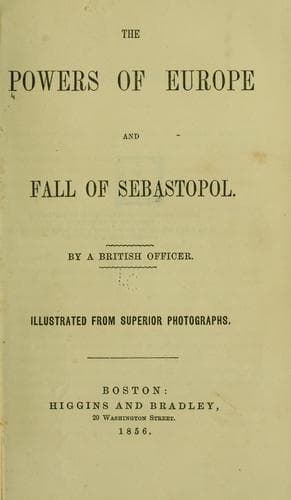
The Powers of Europe and Fall of SebastopolA British officer
History
The Powers of Europe and Fall of Sebastopol
A British officer
Crimean War, 1853-1856; Europe -- History -- 1789-1900
The port of Sebastopol consists of a bay running in a south-easterly
direction, about four miles long, and a mile wide at the entrance,
diminishing to 400 yards at the end, where the Tchernaya or Black
River empties itself. On the southern coast of this bay are the
commercial, military, and careening harbors, the quarantine harbor
being outside the entrance--all these taking a southerly direction,
and having deep water.
The military harbor is the largest, being about a mile and a half
long by 400 yards wide, and is completely land-locked on every side.
Here it is that the Black Sea fleet is moored in the winter--the
largest ships being able to lie with all their stores on board close
to the quays. The small harbor, which contains the naval arsenal
and docks, is on the eastern side of the military harbor, near the
entrance.
The port is defended to the south by six principal batteries and
fortresses, each mounting from 50 to 190 guns; and the north by four,
having from 18 to 120 pieces each; and besides these, there are many
smaller batteries.
The fortresses are built on the casemate principle, three of them
having three tiers of guns, and a fourth two tiers. Fort St.
Nicholas is the largest, and mounts about 190 guns. It is built of
white limestone; a fine, sound stone, which becomes hard, and is
very durable, the same material being used for all the other forts.
Between every two casemates are furnaces for heating shot red hot.
The calibre of the guns is eight inches, capable of throwing shells
or 68-pound solid shot.
Whether all the guns in the fortress are of the same size, it is
impossible to say; but the belief is, that most of the fortifications
of Sebastopol are heavily armed.
Sebastopol is admirably adapted by nature for a strong position
towards the sea, and has been fully taken advantage of to render it
one of the most formidably fortified places in that direction which
could be imagined.
In speaking of the means of defence at Sebastopol, we have left
the Russian fleet out of the question. This, however, is not to be
treated either with indifference or contempt.
There were in the military harbor of Sebastopol twelve line-of-battle
ships, eight frigates, and seven corvettes, comprising the Black Sea
fleet, independent of steamers.
The town of Sebastopol is situated on the point of land between
the commercial and military harbors, which rises gradually from
the water’s edge to an elevation of 200 feet, and contains 31,500
inhabitants. Including the military and marines, the residents
numbered 40,000.
It is more than a mile in length, and its greatest width is about
three-quarters of a mile--the streets entering the open steppe on the
south.
Public-domain text, read in full here on John Shaqi.
Reviews
Reviews
No reviews yet
Be the first to share your thoughts on this work.
Elsewhere in the archive
Join the Discussion
Join the discussion
Sign in to leave a comment or review.
Sign InorCreate an account