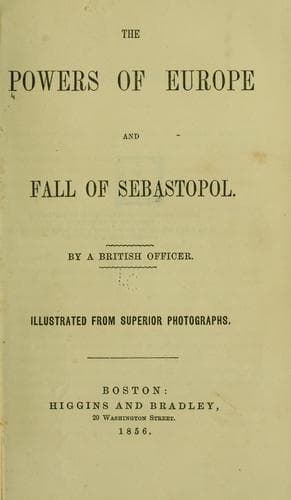
The Powers of Europe and Fall of SebastopolA British officer
History
The Powers of Europe and Fall of Sebastopol
A British officer
Crimean War, 1853-1856; Europe -- History -- 1789-1900
At half-past six, the preconcerted signal of three shells went up,
one after another, from a French battery, and the next instant the
whole Allied batteries opened simultaneously. On the side of the
British, seventy-three, and of the French, fifty-three, in all one
hundred and twenty-six guns, one-half of which were of the very
heaviest calibre, launched their thunders on the side of the Allies;
while upwards of two hundred replied in one deafening roar from the
Russian lines. Two long lines of belching flame and smoke appeared,
and through the space between hurtled a shower of shot and shell,
while the earth shook with the thunders of the deadly volleys.
Distinctly amidst the din could be heard the immense Lancaster guns,
which here, for the first time, gave evidence of their tremendous
powers. Their sharp report, heard among the other heavy guns, was
like the crack of a rifle among muskets. But the most singular thing
was the sound of their ball, which rushed through the air with the
noise and regular beat precisely like the passage of a rapid railway
train at close distance--a peculiarity which, at first, excited
shouts of laughter from the men, who nicknamed it the express-train.
The effect of the shot was terrific; from its deafening and peculiar
noise, the ball could be distinctly traced by the ear to the spot
where it struck, when stone or earth were seen to go down before it.
The first few minutes’ firing sufficed to show to each side, what
neither had as yet accurately known, the actual strength of its
opponents; and it now appeared, that even in the extent of the
earthwork batteries thrown up since the siege began, the Russians
immensely surpassed their besiegers. Besides their stone forts, and
a long line of intrenchments, guns of heavy calibre had been planted
on every ridge and height; and as fresh batteries were unmasked
one after another, often in places totally unexpected, the Allied
generals were completely taken by surprise at the magnitude of the
defences.
Opposite to the French lines, the main strength of the Russians
lay in the Flag-staff batteries, erected upon a hill commanding the
French works. They consisted of two tiers of intrenchments, each
mounting about twenty-five guns, the upper of which tier of cannon
was unknown to the besiegers until it opened fire; with several large
mortars placed on the summit of the hill. And on the extreme right of
the Russian lines was a ten-gun battery, most commandingly placed, so
as to enfilade the French lines.
In this quarter the Russians had not only a great advantage in
point of position, but also their guns outnumbered those of the
French, and it soon became evident that the French were fighting at
a disadvantage, and were dreadfully galled in flank by the ten-gun
battery.
Public-domain text, read in full here on John Shaqi.
Reviews
Reviews
No reviews yet
Be the first to share your thoughts on this work.
Elsewhere in the archive
Join the Discussion
Join the discussion
Sign in to leave a comment or review.
Sign InorCreate an account