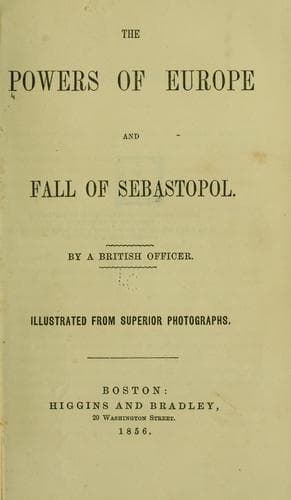
The Powers of Europe and Fall of SebastopolA British officer
History
The Powers of Europe and Fall of Sebastopol
A British officer
Crimean War, 1853-1856; Europe -- History -- 1789-1900
“No power influenced by England can exist upon this continent. If any
desire it, their desire is folly and sooner or later will ruin them.
I shall be obliged to govern Spain; and it will be easy for me to do
it, by establishing a viceroy in each province. However, I will not
refuse to concede my rights of conquest to the king, and to establish
him in Madrid, when the thirty thousand citizens assemble in the
churches, and on the holy sacrament take an oath, not with the mouth
alone, but with the heart, and without any jesuitical restriction,
‘to be true to the king,--to love and support him.’ Let the priests
from the pulpit and in the confessional, the tradesmen in their
correspondence and in their discourses, inculcate these sentiments in
the people; then I will relinquish my rights of conquest, and I will
place the king upon the throne, and I will take a pleasure in showing
myself the faithful friend of the Spaniards.
“The present generation may differ in opinions. Too many passions
have been excited; but your descendants will bless me, as the
regenerator of the nation. They will mark my sojourn among you as
memorable days, and from those days they will date the prosperity of
Spain. These are my sentiments. Go, consult your fellow-citizens;
choose your part, but do it frankly, and exhibit only true colors.”
The ten criminals were the Dukes of Infantado, of Hijah, of
Mediniceli, and Ossuna; Marquis Santa Cruz, Counts Fernan, Minez, and
Altamira; Prince of Castello Franco, Pedro Cevallos, and the Bishop
of St. Ander, were proscribed, body and goods, as traitors to France
and Spain.
Napoleon now made dispositions indicating a vast plan of operations.
But, vast as his plan of campaign appears, it was not beyond the
emperor’s means, for, without taking into consideration his own
genius, activity and vigor, there were upon his muster-rolls above
three hundred and thirty thousand men and above sixty thousand
horse; two hundred pieces of field artillery followed his corps to
battle; and as many more remained in reserve. Of this great army,
however, only two hundred and fifty thousand men and fifty thousand
horses were actually under arms with the different regiments, while
above thirty thousand were detached or in garrisons, preserving
tranquillity in the rear, and guarding the communications of the
active forces. The remainder were in hospitals. Of the whole host,
two hundred and thirteen thousand were native Frenchmen, the residue
were Poles, Germans and Italians; thirty-five thousand men and five
thousand horses were available for fresh enterprise, without taking
a single man from the lines of communication.
Public-domain text, read in full here on John Shaqi.
Reviews
Reviews
No reviews yet
Be the first to share your thoughts on this work.
Join the Discussion
Join the discussion
Sign in to leave a comment or review.
Sign InorCreate an account