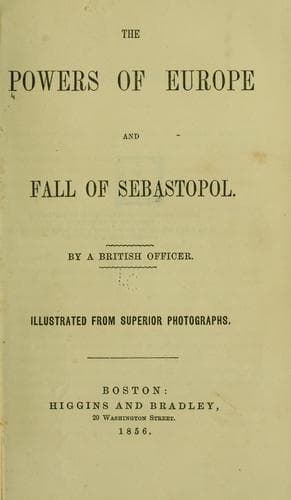
The Powers of Europe and Fall of SebastopolA British officer
History
The Powers of Europe and Fall of Sebastopol
A British officer
Crimean War, 1853-1856; Europe -- History -- 1789-1900
The fate of the Peninsula hung, at this moment, evidently upon a
thread; and the deliverance of that country was due to other causes
than the courage, the patriotism, or the constancy, of the Spaniards.
The strength and spirit of Spain was broken; the enthusiasm was
null, except in a few places, in consequence of the civil wars, and
intestinal divisions incited by the monks and British hirelings; and
the emperor was, with respect to the Spaniards, perfectly master of
operations. He was in the centre of the country; he held the capital,
the fortresses, the command of the great lines of communication
between the provinces; and on the wide military horizon no cloud
interrupted his view, save the city of Saragossa on the one side, and
the British army on the other. “Sooner or later,” said the emperor,
and with truth, “Saragossa must fall.” The subjugation of Spain
seemed inevitable, when, at this instant, the Austrian war broke
out, and this master-spirit was suddenly withdrawn. England then put
forth all her vast resources, and the genius and vigor of Sir John
Moore, aided, most fortunately, by the absence of Napoleon, and the
withdrawal of the strength of his army for the subjugation of the
Peninsula; and it was delivered from the French, after oceans of
blood had been spilt and millions of treasure wasted, to fall into
the hands of the not less tyrannical and oppressive English. “But
through what changes of fortune, by what unexpected helps, by what
unlooked-for events,--under what difficulties, by whose perseverance,
and in despite of whose errors,--let posterity judge; for in that
judgment,” says Napier, “only will impartiality and justice be found.”
Tidings having reached the emperor that the Austrian army was about
to invade France, he recalled a large portion of his army, and
appointing his brother Joseph to be his lieutenant-general, he
allotted separate provinces to each corps d’armée, and directing the
imperial guard to hasten to France, he returned to Valladolid, where
he received the addresses of the nobles and deputies of Madrid, and
other great towns; and after three days’ delay, he departed himself,
with scarcely any escort, but with such astonishing speed as to
frustrate the designs which some Spaniards had, in some way, formed
against his person.
Public-domain text, read in full here on John Shaqi.
Reviews
Reviews
No reviews yet
Be the first to share your thoughts on this work.
Join the Discussion
Join the discussion
Sign in to leave a comment or review.
Sign InorCreate an account