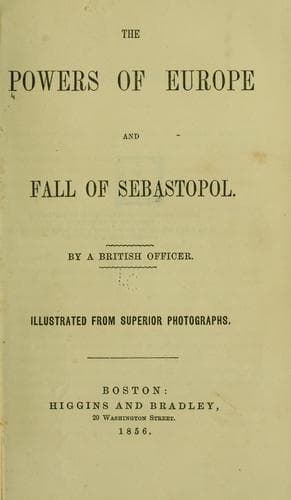
The Powers of Europe and Fall of SebastopolA British officer
History
The Powers of Europe and Fall of Sebastopol
A British officer
Crimean War, 1853-1856; Europe -- History -- 1789-1900
The general command of the French army in Spain was left with Soult,
assisted by Ney. This gallant general, bearing the title of the
Duke of Dalmatia, commenced his pursuit of the English army with
a vigor that marked his eager desire to finish the campaign in a
manner suitable to its brilliant opening. Sir John Moore had arrived
in Salamanca by the middle of November, and on the 23d the other
divisions of the army had arrived at the stations assigned them.
Sir David Baird had already reported himself at Astorga, when Moore
received positive information that the French had entered Valladolid
in great force. And this place was only three days’ march distant
from the British. At a glance, the great mind of Moore comprehended
the full difficulty of his critical situation. In the heart of a
foreign country, unsupported by the Spanish government, his army
wanting the very necessaries of life, he found himself obliged to
commence that retreat in winter, over mountains covered with snow,
which proved so fatal to the British army, or wait to meet the French
troops, flushed with victory, and sustained by an overwhelming force.
In vain he appealed to the junta of Salamanca for aid. In vain he
endeavored to arouse the spirit of patriotism, which had shone forth
so brightly in the first days of the insurrection. Instead of aiding
him either to advance or retreat, they endeavored to direct him what
course to pursue; and painted, with true Spanish pride and hyperbole,
in glowing colors, what their armies had done, and what they could
do. His camp was therefore struck, and he retreated through the
rocks of Gallicia, closely followed by the pursuing army. Whenever
the advance guards of the enemy approached, the British rallied with
vigor, and sustained their reputation for bravery; but they displayed
a lamentable want of discipline in all other parts of their conduct.
The weather was tempestuous; the roads miserable; the commissariat
was utterly defective, and the very idea that they were retreating
was sufficient to crush the spirits of the soldiery. At Bembibre,
although the English well knew that the French were close behind,
they broke into the immense wine-vaults of that city. All effort by
their officers to control them was utterly useless. Hundreds became
so inebriated as to be unable to proceed, and Sir John Moore was
obliged to proceed without them. Scarcely had the reserve marched out
of the village, when the French cavalry appeared. In a moment the
road was filled with the miserable stragglers, who came crowding
after the troops, some with shrieks of distress and wild gestures,
others with brutal exclamations; while many, overcome with fear,
threw away their arms, and those who preserved them were too stupidly
intoxicated to fire, and kept reeling to and fro, alike insensible
to their danger and disgrace. The enemy’s horsemen, perceiving this,
bore at a gallop through the disorderly mob, cutting to the right
Public-domain text, read in full here on John Shaqi.
Reviews
Reviews
No reviews yet
Be the first to share your thoughts on this work.
Elsewhere in the archive
Join the Discussion
Join the discussion
Sign in to leave a comment or review.
Sign InorCreate an account