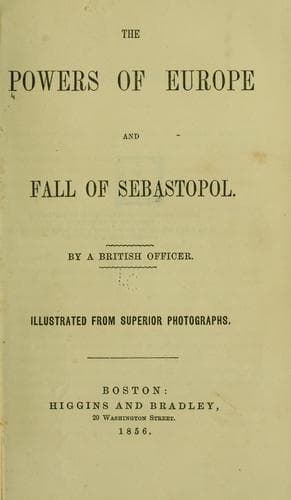
The Powers of Europe and Fall of SebastopolA British officer
History
The Powers of Europe and Fall of Sebastopol
A British officer
Crimean War, 1853-1856; Europe -- History -- 1789-1900
hide her from sight,--the only burial that could be afforded; and
the infants were given in charge to a woman who came up in one of
the carts, little likely, as it was, that they could survive such a
journey.”
Soult hung close on the rear of this unfortunate army, and pursued
them until they reached Corunna, on the 12th of January. As the
morning dawned, the weary and unfortunate general, saddened by the
dark scenes through which he had passed, sensible that the soldiers
were murmuring at their retreat, unsupported by his Spanish allies,
and well aware that rumor and envy and misunderstanding would be
busy with his name in his own native land, appeared on the heights
that overhung the town. With eager and anxious gaze, he turned to
the harbor, hoping to perceive there his fleet, which he had ordered
to sail from Vigo. But the same moody fortune which had followed
him during his whole career pursued him here. The wintry sun looked
down upon the foaming ocean, and only the vast expanse of water
met his view. The fleet, detained by contrary winds, was nowhere
visible; and once more he was obliged to halt with his forces, and
take up quarters. The army was posted on a low ridge, and waited
for the French to come up. The sadness of the scene was by no means
passed. Here, stored in Corunna, was a large quantity of ammunition,
sent over from England, and for the want of which both the Spanish
and English forces had suffered, and which Spanish idleness and
improvidence had suffered to remain here for months, unappropriated.
This must now be destroyed, or fall into the possession of the enemy.
Three miles from the town were piled four thousand barrels of powder
on a hill, and a smaller quantity at some distance from it. On the
morning of the 13th, the inferior magazine blew up, with a terrible
noise, and shook the houses in the town; but when the train reached
the great store, there ensued a crash like the bursting forth of a
volcano;--the earth trembled for miles, the rocks were torn from
their bases, and the agitated waters rolled the vessels, as in a
storm; a vast column of smoke and dust, shooting out fiery sparks
from its sides, arose perpendicularly and slowly to a great height,
and then a shower of stones and fragments of all kinds, bursting out
of it with a roaring sound, killed many persons who remained too
near the spot. Stillness, slightly interrupted by the lashing of the
waves on the shore, succeeded, and then the business of the day went
on. The next scene was a sad one. All the horses of the army were
collected together, and, as it was impossible to embark them in face
of the enemy, they were ordered to be shot. These poor animals would
otherwise have been distributed among the French cavalry, or used as
draft-horses.
Public-domain text, read in full here on John Shaqi.
Reviews
Reviews
No reviews yet
Be the first to share your thoughts on this work.
Elsewhere in the archive
Join the Discussion
Join the discussion
Sign in to leave a comment or review.
Sign InorCreate an account