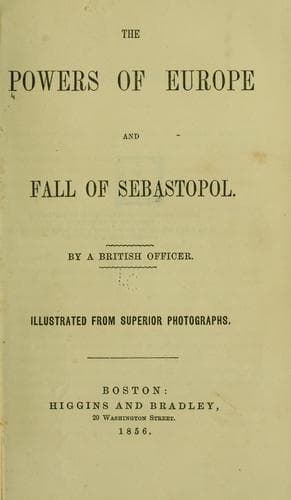
The Powers of Europe and Fall of SebastopolA British officer
History
The Powers of Europe and Fall of Sebastopol
A British officer
Crimean War, 1853-1856; Europe -- History -- 1789-1900
On the 14th, the transports from Vigo arrived. The dismounted
cavalry, the sick and wounded, the best horses, belonging to the
officers, which had been saved, and fifty-two pieces of artillery,
were embarked during the night, only retaining twelve guns on shore,
ready for action. And now the closing scene of this sad drama was
rapidly approaching, giving a melancholy but graceful termination to
the campaign.
On the night of the 15th, everything was shipped that was destined
to be removed, excepting the fighting men. These were intending to
embark, as soon as the darkness should permit them to move without
being perceived, on the night of the 16th; but in the afternoon the
French troops drew up, and offered battle. This the English general
would not refuse, and the action soon became general. The battle
was advancing, with varied fortune, when Sir John Moore, who was
earnestly watching the result of the battle in the village of Elvina,
received his death-wound. A spent cannon-ball struck him on his
breast. The shock threw him from his horse, with violence; but he
rose again, in a sitting posture, his countenance unchanged, and his
steadfast eye still fixed on the regiments before him, and betraying
no signs of pain. In a few moments, when satisfied that his troops
were gaining ground, his countenance brightened, and he suffered
himself to be carried to the rear. Then was seen the dreadful nature
of his hurt. The shoulder was shattered to pieces; the arm was
hanging by a piece of skin; the ribs over the heart were broken and
bared of flesh, and the muscles of the breast torn into long strips,
which were interlaced by their recoil from the dragging shot. As
the soldiers placed him in a blanket, his sword got entangled, and
the hilt entered the wound. Captain Hardinge, a staff officer, who
was near, attempted to take it off; but the dying man stopped him,
saying, “It is as well as it is; I had rather it should go out of the
field with me.” And in that manner, so becoming to a soldier, he was
borne from the fight by his devoted men, who went up the hill weeping
as they went. The blood flowed fast, and the torture of his wound was
great; yet, such was the unshaken firmness of his mind, that those
about him judged, from the resolution of his countenance, that his
hurt was not mortal, and said so to him. He looked steadfastly at
the wound for a few moments, and then said, “No,--I feel that to be
impossible.” Several times he caused his attendants to turn around,
that he might behold the field of battle; and, when the firing
indicated the advance of the British, he discovered his satisfaction,
and permitted his bearers to proceed. Being brought to his lodgings,
the surgeon examined his wound, but there was no hope. The pain
increased, and he spoke with great difficulty. Addressing an old
friend, he said, “You know that I always wished to die this way.”
Again he asked if the enemy were defeated; and being told that they
Public-domain text, read in full here on John Shaqi.
Reviews
Reviews
No reviews yet
Be the first to share your thoughts on this work.
Elsewhere in the archive
Join the Discussion
Join the discussion
Sign in to leave a comment or review.
Sign InorCreate an account