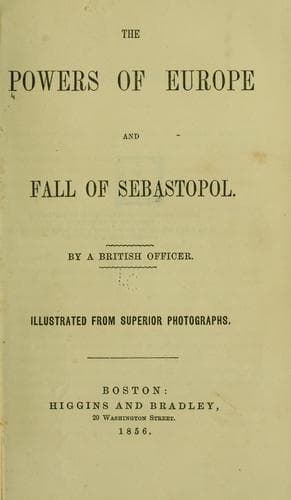
The Powers of Europe and Fall of SebastopolA British officer
History
The Powers of Europe and Fall of Sebastopol
A British officer
Crimean War, 1853-1856; Europe -- History -- 1789-1900
When the last of the enemy had disappeared in the distance, the
troops were all summoned to the field of battle. We collected there,
and gazed around with saddened hearts. Four hours ago, and there
was not one, of all that now lay lifeless on that bloody field,
whose heart did not beat as high as our own, whose hopes were not
as brilliant; and yet, their sun had now set forever! I know of
no sadder scene than a field of battle presents soon after the
conflict, even though the glorious result may have filled our hearts
with joy. When the roll is called, and name after name uttered
without response, it cannot but awaken the deepest sensibility in
the heart of the survivors. And then the hasty burial of the dead,
and the hurried sending off the wounded, the surgeon’s necessary
operations, and the groans of the sufferers, all make us feel
that these are the horrors of war. Before the battle is the rapid
marching and counter-marching, and the enlivening strains of martial
music, the encouraging words of the officers,--more than all, the
excitement which must exist in such a scene,--and all these serve to
elevate and sustain the spirits. During the contest the excitement
increases, until all sense of fear and danger is lost. But one
thing is seen--the foe;--but one object exists--to conquer. When
all these have passed away, and there is no longer aught to excite,
then the eye opens on stern and dread reality, and we realize what
we have escaped, and the pain and suffering ever attendant on such
scenes. There is something awfully trying to the soul, when the
last sad rites are being performed for those so lately buoyant in
life and health,--especially when we meet with the corpses of those
we have known and loved. I have seen many affecting instances of
such recognitions. Among others that I might name, is that of a
French captain of dragoons, who came over after the battle with a
trumpet, and requested permission to search among the dead for his
colonel. His regiment was a fine one, with bright brass helmets and
black horse-hair, bearing a strong resemblance to the costume of
the ancient Romans. Many of our own soldiers accompanied him in his
melancholy search. It was long before we found the French colonel,
for he was lying on his face, his naked body weltering in blood. As
soon as he was turned over, the captain recognized him. He uttered
a sort of agonizing scream, sprang off his horse, dashed his helmet
on the ground, knelt by the body, and, taking the bloody hand in his
own, kissed it many times, in an agony of grief. He seemed entirely
to forget, in his sorrow, that any one was present. We afterwards
learned that the colonel had, in his youth, done him a great service,
by releasing him from the police when evil company had led him to
the commission of some crime. It was his first act of the kind; and
gratitude to the colonel led to an immediate enlistment in his corps.
From that hour he had been to the captain as a father, and it was
Public-domain text, read in full here on John Shaqi.
Reviews
Reviews
No reviews yet
Be the first to share your thoughts on this work.
Elsewhere in the archive
Join the Discussion
Join the discussion
Sign in to leave a comment or review.
Sign InorCreate an account