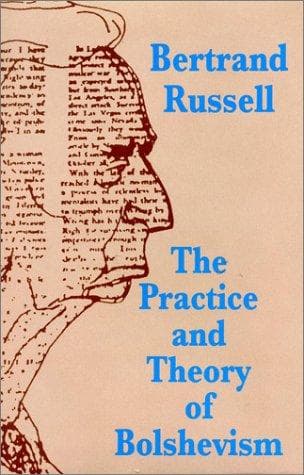
The Practice and Theory of BolshevismRussell, Bertrand
Religion
The Practice and Theory of Bolshevism
Russell, Bertrand
Communism -- Soviet Union -- History; Soviet Union -- Social conditions
The Government supplies rations to every one who works in the towns at
a very low fixed price. The official theory is that the Government has
a monopoly of the food and that the rations are sufficient to sustain
life. The fact is that the rations are not sufficient, and that they
are only a portion of the food supply of Moscow. Moreover, people
complain, I do not know how truly, that the rations are delivered
irregularly; some say, about every other day. Under these
circumstances, almost everybody, rich or poor, buys food in the
market, where it costs about fifty times the fixed Government price.
A pound of butter costs about a month's wages. In order to be able to
afford extra food, people adopt various expedients. Some do additional
work, at extra rates, after their official day's work is over. For,
though there is supposed to be by law an eight-hours day, extended to
ten in certain vital industries, the wage paid for it is not a living
wage, and there is nothing to prevent a man from undertaking other
work in his spare time. But the usual resource is what is called
"speculation," i.e., buying and selling. Some person formerly rich
sells clothes or furniture or jewellery in return for food; the buyer
sells again at an enhanced price, and so on through perhaps twenty
hands, until a final purchaser is found in some well-to-do peasant or
_nouveau riche_ speculator. Again, most people have relations in the
country, whom they visit from time to time, bringing back with them
great bags of flour. It is illegal for private persons to bring food
into Moscow, and the trains are searched; but, by corruption or
cunning, experienced people can elude the search. The food market is
illegal, and is raided occasionally; but as a rule it is winked at.
Thus the attempt to suppress private commerce has resulted in an
amount of unprofessional buying and selling which far exceeds what
happens in capitalist countries. It takes up a great deal of time
that might be more profitably employed; and, being illegal, it places
practically the whole population of Moscow at the mercy of the police.
Moreover, it depends largely upon the stores of goods belonging to
those who were formerly rich, and when these are expended the whole
system must collapse, unless industry has meanwhile been
re-established on a sound basis.
Public-domain text, read in full here on John Shaqi.
Reviews
Reviews
No reviews yet
Be the first to share your thoughts on this work.
Elsewhere in the archive
Join the Discussion
Join the discussion
Sign in to leave a comment or review.
Sign InorCreate an account