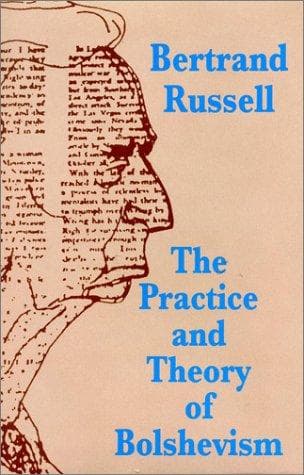
The Practice and Theory of BolshevismRussell, Bertrand
Religion
The Practice and Theory of Bolshevism
Russell, Bertrand
Communism -- Soviet Union -- History; Soviet Union -- Social conditions
The most obvious non-economic factor, and the one the neglect of which
has led Socialists most astray, is nationalism. Of course a nation,
once formed, has economic interests which largely determine its
politics; but it is not, as a rule, economic motives that decide what
group of human beings shall form a nation. Trieste, before the war,
considered itself Italian, although its whole prosperity as a port
depended upon its belonging to Austria. No economic motive can account
for the opposition between Ulster and the rest of Ireland. In Eastern
Europe, the Balkanization produced by self-determination has been
obviously disastrous from an economic point of view, and was demanded
for reasons which were in essence sentimental. Throughout the war
wage-earners, with only a few exceptions, allowed themselves to be
governed by nationalist feeling, and ignored the traditional Communist
exhortation: "Workers of the world, unite." According to Marxian
orthodoxy, they were misled by cunning capitalists, who made their
profit out of the slaughter. But to any one capable of observing
psychological facts, it is obvious that this is largely a myth.
Immense numbers of capitalists were ruined by the war; those who were
young were just as liable to be killed as the proletarians were. No
doubt commercial rivalry between England and Germany had a great deal
to do with causing the war; but rivalry is a different thing from
profit-seeking. Probably by combination English and German capitalists
could have made more than they did out of rivalry, but the rivalry
was instinctive, and its economic form was accidental. The capitalists
were in the grip of nationalist instinct as much as their proletarian
"dupes." In both classes some have gained by the war; but the
universal will to war was not produced by the hope of gain. It was
produced by a different set of instincts, and one which Marxian
psychology fails to recognize adequately.
The Marxian assumes that a man's "herd," from the point of view of
herd-instinct, is his class, and that he will combine with those whose
economic class-interest is the same as his. This is only very
partially true in fact. Religion has been the most decisive factor in
determining a man's herd throughout long periods of the world's
history. Even now a Catholic working man will vote for a Catholic
capitalist rather than for an unbelieving Socialist. In America the
divisions in local elections are mainly on religious lines. This is no
doubt convenient for the capitalists, and tends to make them religious
men; but the capitalists alone could not produce the result. The
result is produced by the fact that many working men prefer the
advancement of their creed to the improvement of their livelihood.
However deplorable such a state of mind may be, it is not necessarily
due to capitalist lies.
Public-domain text, read in full here on John Shaqi.
Reviews
Reviews
No reviews yet
Be the first to share your thoughts on this work.
Elsewhere in the archive
Join the Discussion
Join the discussion
Sign in to leave a comment or review.
Sign InorCreate an account