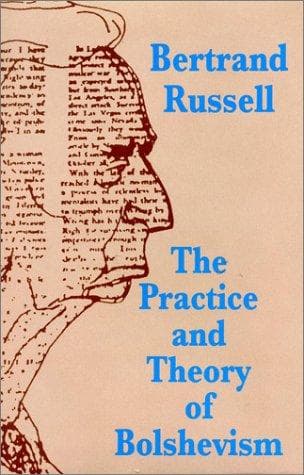
The Practice and Theory of BolshevismRussell, Bertrand
Religion
The Practice and Theory of Bolshevism
Russell, Bertrand
Communism -- Soviet Union -- History; Soviet Union -- Social conditions
For those who do not like this method, there is another: the study of
scientific psychology and physiology. The physiological causes of
emotions have begun to be known, through the studies of such men as
Cannon (_Bodily Changes in Pain, Hunger, Fear and Rage_). In time, it
may become possible, by physiological means, to alter the whole
emotional nature of a population. It will then depend upon the
passions of the rulers how this power is used. Success will come to
the State which discovers how to promote pugnacity to the extent
required for external war, but not to the extent which would lead to
domestic dissensions. There is no method by which it can be insured
that rulers shall desire the good of mankind, and therefore there is
no reason to suppose that the power to modify men's emotional nature
would cause progress.
If men desired to diminish rivalry, there is an obvious method. Habits
of power intensify the passion of rivalry; therefore a State in which
power is concentrated will, other things being equal, be more
bellicose than one in which power is diffused. For those who dislike
wars, this is an additional argument against all forms of
dictatorship. But dislike of war is far less common than we used to
suppose; and those who like war can use the same argument to support
dictatorship.
III
BOLSHEVIK CRITICISM OF DEMOCRACY
The Bolshevik argument against Parliamentary democracy as a method of
achieving Socialism is a powerful one. My answer to it lies rather in
pointing out what I believe to be fallacies in the Bolshevik method,
from which I conclude that no swift method exists of establishing any
desirable form of Socialism. But let us first see what the Bolshevik
argument is.
In the first place, it assumes that those to whom it is addressed are
absolutely certain that Communism is desirable, so certain that they
are willing, if necessary, to force it upon an unwilling population at
the point of the bayonet. It then proceeds to argue that, while
capitalism retains its hold over propaganda and its means of
corruption, Parliamentary methods are very unlikely to give a majority
for Communism in the House of Commons, or to lead to effective action
by such a majority even if it existed. Communists point out how the
people are deceived, and how their chosen leaders have again and
again betrayed them. From this they argue that the destruction of
capitalism must be sudden and catastrophic; that it must be the work
of a minority; and that it cannot be effected constitutionally or
without violence. It is therefore, in their view, the duty of the
Communist party in a capitalist country to prepare for armed conflict,
and to take all possible measure for disarming the bourgeoisie and
arming that part of the proletariat which is willing to support the
Communists.
Public-domain text, read in full here on John Shaqi.
Reviews
Reviews
No reviews yet
Be the first to share your thoughts on this work.
Elsewhere in the archive
Join the Discussion
Join the discussion
Sign in to leave a comment or review.
Sign InorCreate an account