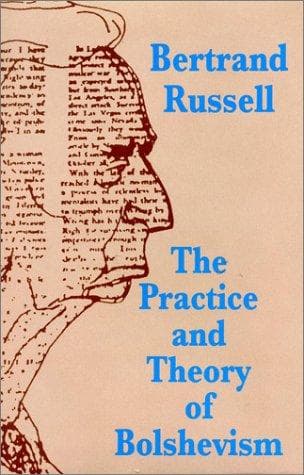
The Practice and Theory of BolshevismRussell, Bertrand
Religion
The Practice and Theory of Bolshevism
Russell, Bertrand
Communism -- Soviet Union -- History; Soviet Union -- Social conditions
I think we come here to an essential part of Bolshevik philosophy. In
the moment of revolution, Communists are to have some popular cry by
which they win more support than mere Communism could win. Having thus
acquired the State machine, they are to use it for their own ends. But
this, again, is a method which can only be practised successfully so
long as it is not avowed. It is to some extent habitual in politics.
The Unionists in 1900 won a majority on the Boer War, and used it to
endow brewers and Church schools. The Liberals in 1906 won a majority
on Chinese labour, and used it to cement the secret alliance with
France and to make an alliance with Tsarist Russia. President Wilson,
in 1916, won his majority on neutrality, and used it to come into the
war. This method is part of the stock-in-trade of democracy. But its
success depends upon repudiating it until the moment comes to practise
it. Those who, like the Bolsheviks, have the honesty to proclaim in
advance their intention of using power for other ends than those for
which it was given them, are not likely to have a chance of carrying
out their designs.
What seems to me to emerge from these considerations is this: That in
a democratic and politically educated country, armed revolution in
favour of Communism would have no chance of succeeding unless it were
supported by a larger majority than would be required for the election
of a Communist Government by constitutional methods. It is possible
that, if such a Government came into existence, and proceeded to carry
out its programme, it would be met by armed resistance on the part of
capital, including a large proportion of the officers in the army and
navy. But in subduing this resistance it would have the support of
that great body of opinion which believes in legality and upholds the
constitution. Moreover, having, by hypothesis, converted a majority of
the nation, a Communist Government could be sure of loyal help from
immense numbers of workers, and would not be forced, as the
Bolsheviks are in Russia, to suspect treachery everywhere. Under these
circumstances, I believe that the resistance of the capitalists could
be quelled without much difficulty, and would receive little support
from moderate people. Whereas, in a minority revolt of Communists
against a capitalist Government, all moderate opinion would be on the
side of capitalism.
Public-domain text, read in full here on John Shaqi.
Reviews
Reviews
No reviews yet
Be the first to share your thoughts on this work.
Elsewhere in the archive
Join the Discussion
Join the discussion
Sign in to leave a comment or review.
Sign InorCreate an account