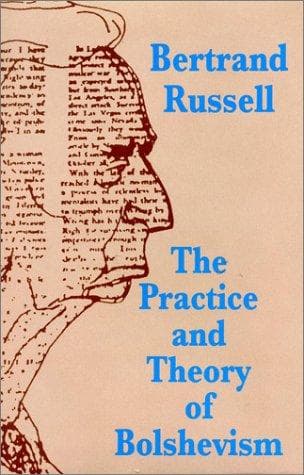
The Practice and Theory of BolshevismRussell, Bertrand
Religion
The Practice and Theory of Bolshevism
Russell, Bertrand
Communism -- Soviet Union -- History; Soviet Union -- Social conditions
To cure this evil is not easy, because efficiency is promoted, at any
given moment, though not in the long run, by sacrificing the
individual to the smooth working of a vast organization, whether
military or industrial. In war and in commercial competition, it is
necessary to control individual impulses, to treat men as so many
"bayonets" or "sabres" or "hands," not as a society of separate people
with separate tastes and capacities. Some sacrifice of individual
impulses is, of course, essential to the existence of an ordered
community, and this degree of sacrifice is, as a rule, not regretable
even from the individual's point of view. But what is demanded in a
highly militarized or industrialized nation goes far beyond this very
moderate degree. A society which is to allow much freedom to the
individual must be strong enough to be not anxious about home defence,
moderate enough to refrain from difficult external conquests, and rich
enough to value leisure and a civilized existence more than an
increase of consumable commodities.
But where the material conditions for such a state of affairs exist,
the psychological conditions are not likely to exist unless power is
very widely diffused throughout the community. Where power is
concentrated in a few, it will happen, unless those few are very
exceptional people, that they will value tangible achievements in the
way of increase in trade or empire more than the slow and less obvious
improvements that would result from better education combined with
more leisure. The joys of victory are especially great to the holders
of power, while the evils of a mechanical organization fall almost
exclusively upon the less influential. For these reasons, I do not
believe that any community in which power is much concentrated will
long refrain from conflicts of the kind involving a sacrifice of what
is most valuable in the individual. In Russia at this moment, the
sacrifice of the individual is largely inevitable, because of the
severity of the economic and military struggle. But I did not feel, in
the Bolsheviks, any consciousness of the magnitude of this misfortune,
or any realization of the importance of the individual as against the
State. Nor do I believe that men who do realize this are likely to
succeed, or to come to the top, in times when everything has to be
done against personal liberty. The Bolshevik theory requires that
every country, sooner or later, should go through what Russia is going
through now. And in every country in such a condition we may expect to
find the government falling into the hands of ruthless men, who have
not by nature any love for freedom, and who will see little importance
in hastening the transition from dictatorship to freedom. It is far
more likely that such men will be tempted to embark upon new
enterprises, requiring further concentration of forces, and postponing
indefinitely the liberation of the populations which they use as their
material.
Public-domain text, read in full here on John Shaqi.
Reviews
Reviews
No reviews yet
Be the first to share your thoughts on this work.
Elsewhere in the archive
Join the Discussion
Join the discussion
Sign in to leave a comment or review.
Sign InorCreate an account