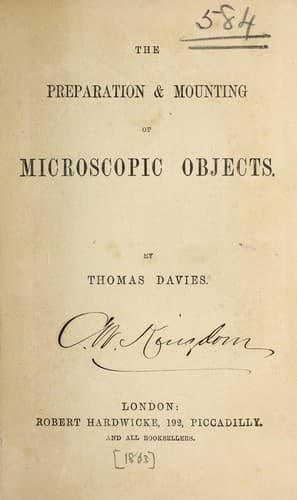
The preparation & mounting of microscopic objectsDavies, Thomas
Science
The preparation & mounting of microscopic objects
Davies, Thomas
Microscopy -- Technique
Another interesting object to the young microscopist is afforded by the
spores of the equiseta (or horsetails, as they are often called). These
may be obtained by shaking the higher portion of the stems when the
spores are ripe. They will then fall like small dust, and may be placed
under the microscope. The spores are then seen to consist of a somewhat
heart-shaped mass with bands rather intricately curled around it. As
they dry these bands expand, and are seen to be four lines at right
angles, with the ends clubbed, as it may be called. If, whilst watching
them, the spores are breathed upon, these bands immediately return to
their former state, and are closely curled around the spore; but as
they gradually dry again expand. This experiment may be repeated many
times, and is a very interesting one.
The above are the principal objects which could not possibly be
included in any of the former chapters, but would have left a most
interesting branch untouched had it been neglected. There is another
subject also which should not be passed by--viz., the production of
minute pictures which serve as objects for microscopic examination.
I may here mention that as this manual is simply to enable the
young student to prepare and mount his objects, the photography of
_magnified_ objects has evidently no place here.
Few slides caused so much astonishment as these minute photographs when
first exhibited; small spots were seen to contain large pictures, and a
page of printed matter was compressed into the one-hundredth part of a
square inch. It would be impossible in this place to give the inquirer
any instruction in the manipulation of photography, so it must be
assumed that he already knows this.
We will first consider the process performed by artificial light. The
collodion employed in photographing generally shows as much structure
when magnified as is found in linen of moderate texture; but this is
not always the case, as some samples bear much enlargement without any
of this appearance. It is evident that a structure so coarse would make
it entirely unfit for these minute pictures, as all the small markings
would be destroyed, or so interfered with that no great enlargement
would be practicable. To obtain almost structureless collodion is not
an easy matter, and a clever practitioner in this branch of photography
states that he knows of no method to accomplish this with certainty,
but he himself tries different samples until he falls upon a suitable
one, which he then lays aside for this object. A beneficial effect
is often derived from keeping the collodion awhile, but this is not
always the case. The slides should be chosen of an equal thickness,
so that when focussed upon one no re-adjustment may be necessary for
the others. The glass should, of course, be free from any roughness,
scratches, or other imperfections, and of first-rate quality and colour.
Public-domain text, read in full here on John Shaqi.
Reviews
Reviews
No reviews yet
Be the first to share your thoughts on this work.
Elsewhere in the archive
Join the Discussion
Join the discussion
Sign in to leave a comment or review.
Sign InorCreate an account