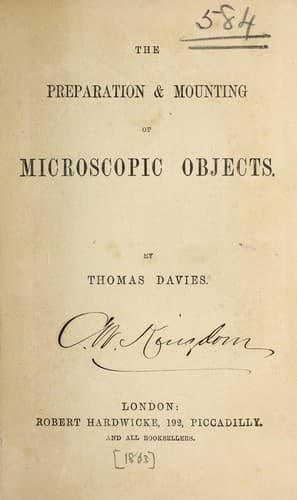
The preparation & mounting of microscopic objectsDavies, Thomas
Science
The preparation & mounting of microscopic objects
Davies, Thomas
Microscopy -- Technique
Make a saturated solution of the two sulphates, combined in the
proportion of three parts copper to one part magnesia, and then add
to the solution one-tenth of pure water. Dust or other impurities
should be guarded against, and the slide made free from all trace
of grease by cleaning immediately before use with liquor potassæ or
ammonia. A drop of the solution should then be placed upon the slide,
and by a thin glass rod spread evenly upon the surface. Heat this
whilst in a horizontal position until the salt remains as a viscous
transparent substance, which will not be effected until it is raised
to a high degree. The slide may now be allowed to cool, and when this
is accomplished, the flower-like crystals will be perceived forming
here and there upon the plate. When these are at any stage in which it
is wished to preserve them, a few seconds’ exposure to the fire, as
warm as the hand can comfortably bear, will stop the expansion, when
the portion which we wish to mount should be cut off from the mass of
salt by simply scratching the film around, and pure Canada balsam with
the thin glass used. Breathing upon the film, or allowing the slide to
become cold and attract the moisture from the atmosphere, will cause
the crystallization to extend, and sometimes greatly rob the effect; so
it is necessary to mount quickly when the desired forms are obtained.
As the crystals are very uncertain as to the place of their formation,
I may here mention that they may be got in _any_ part of the slide
by piercing the film with a needle-point; but in some degree this
necessarily interferes with the centre. As the cause of this has no
need to be entered into here, and has been elsewhere discussed, I shall
only give the above directions, and say that there is a great field in
this branch of study which the microscope alone has opened.
It would be useless to enter into particulars respecting the various
salts and treatment they require, as a great difference is effected
even by the strength of the solution. There are some crystals, also,
which are called forth in insulated portions, showing no formation
upon the ground; but even when mounted in any preserving fluid, and
unchanged for a year, a new action seems to arise, and a groundwork
is produced which bears little resemblance to the original crystal.
Sometimes this new formation adds to the beauty of the slide; in other
cases the reverse is the result, the slide being rendered almost
worthless. This action, I believe, frequently arises from some liquid
being contained in the balsam or other mounting medium used; and this
is rendered the more probable by the crystallization being called
forth in an hour after the balsam diluted with chloroform is employed,
whereas no change would have taken place for months (if at all) had
pure balsam been used.
Sections of some of the salts are very interesting objects, but the
method of procuring these and their nature will be described in Chapter
V.
Public-domain text, read in full here on John Shaqi.
Reviews
Reviews
No reviews yet
Be the first to share your thoughts on this work.
Elsewhere in the archive
Join the Discussion
Join the discussion
Sign in to leave a comment or review.
Sign InorCreate an account