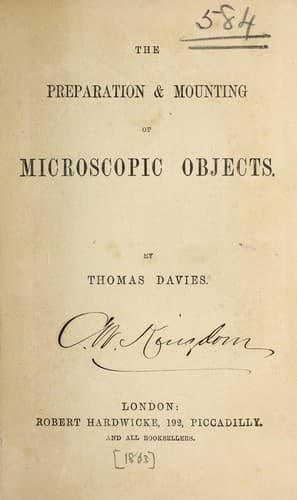
The preparation & mounting of microscopic objectsDavies, Thomas
Science
The preparation & mounting of microscopic objects
Davies, Thomas
Microscopy -- Technique
Amongst those which are generally esteemed, the most beautiful are the
crystals of oxalurate of ammonia. The preparation of this salt from
uric acid and ammonia is a rather difficult process, and will not on
that account be described here; but when possessed, a small quantity
of a strong solution in water must be made, and a little placed
on the slide, and evaporated slowly. Part of the salt will then be
deposited in circles with the needle-like crystals extending from
common centres. They should then be mounted in pure Canada balsam;
and, when the best colours are wanted, used with the selenite plate.
Of this class of crystal salicine is a universal favourite, and can be
easily procured of most chemists. The crystals may be produced in two
ways:--A small portion of the salt must be placed upon the slide, and a
strong heat applied underneath until fusion ensues; the matter should
then be evenly and thinly spread over the surface. In a short time
the crystals will form, and are generally larger than those procured
by the following process; but the uncertainty is increased a little
when fusion is used, which, however, is desirable with many salts.
Secondly, make a saturated solution of salicine, which in cold water
is effected by adding one part of the salt to eighteen parts of water.
Lay a little upon the slide, and allow it to evaporate spontaneously,
or with the aid of gentle heat. The crystals are generally uniform, and
with ordinary powers quite large enough to afford a beautiful object.
The circular shape and gorgeous colours of this crystal have made it so
great a favourite that there are few cabinets without it.
Many new forms may be procured by uniting two totally different salts
in solution in certain proportions. This is a field affording new
facts and beauties; but requires some chemical knowledge and much
perseverance to obtain very valuable results. One of the most beautiful
I have met with has been composed of sulphate of copper and sulphate of
magnesia. The flower-like forms and uniformity of crystallization when
successful make it well worth a few failures at first; and as I became
acquainted with some new facts in my frequent trials, I will give the
preparation of the double salt from the beginning.
Public-domain text, read in full here on John Shaqi.
Reviews
Reviews
No reviews yet
Be the first to share your thoughts on this work.
Join the Discussion
Join the discussion
Sign in to leave a comment or review.
Sign InorCreate an account