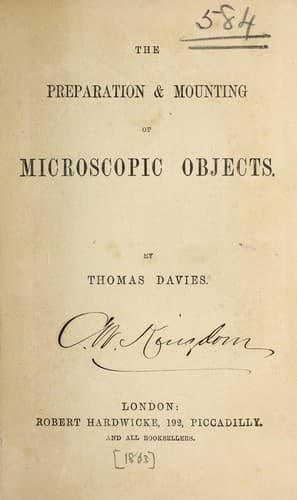
The preparation & mounting of microscopic objectsDavies, Thomas
Science
The preparation & mounting of microscopic objects
Davies, Thomas
Microscopy -- Technique
PRESERVATIVE LIQUIDS, ETC., PARTICULARLY WHERE CELLS ARE USED.
There are many objects which would lose all their distinctive
peculiarities if allowed to become dry, especially those belonging
to the fresh-water Algæ, many animal tissues, and most of the very
delicate animal and vegetable substances in which structure is to be
shown. These must be preserved by immersion in some fluid; but it is
evident that the fluid must be suited to the kind of matter which it
is intended to preserve. As it often requires much study and trouble
to _obtain_ microscopic objects of this class, it is well that their
_preservation_ should be rendered as perfect as possible; and for this
reason the CELLS, or receptacles of the fluids, should be so closed
that all possibility of escape should be prevented. The accomplishment
of this is not so easy a matter as it might appear to the inexperienced.
Before giving any directions as to the manipulation required in
mounting the objects, we must consider the different _liquids_ and
_cells_ which are requisite for their preservation. Of the former there
are a great number, of which the principal may be mentioned.
DISTILLED WATER is strongly recommended by many for Diatomaceæ and
other Protophytes. It has been, however, stated that confervoid growths
often disturb the clearness of the liquid, and on this account various
additions are made to it. A lump of camphor is often left in the
bottle, so that the water may dissolve as much as possible. One grain
of bay-salt and one of alum are added to each ounce of water; or a drop
or two of creosote shaken up with the ounce of water, which should be
afterwards filtered. These additions are often made; perhaps each of
them good for certain objects.
GLYCERINE.--Some affirm this to be one of the best preservative
liquids, especially for vegetable objects; but others think that it is
much better when diluted with two parts of camphor-water, prepared as
above.[E]
[E] Dr. Carpenter says:--“Glycerine has a solvent power for
carbonate of lime, and should not be employed when the
object contains any calcareous structure. In ignorance
of this fact, the author (Dr. C.) employed glycerine to
preserve a number of remarkably fine specimens of the
pentacrinoid larva of the Comatula, whose colours he was
anxious to retain; and was extremely vexed to find, when
about to mount them, that their calcareous skeletons had so
entirely disappeared, that the specimens were completely
ruined.”
GLYCERINE AND GUM.--This is also believed to be a very good liquid for
vegetable tissues, and is thus prepared:--
Pure gum-arabic 1 oz.
Glycerine 1 ”
Water (distilled) 1 ”
Arsenious acid 1½ grains.
Dissolve the arsenious acid in the cold water, then the gum, add the
glycerine, and mix without bubbles.
Public-domain text, read in full here on John Shaqi.
Reviews
Reviews
No reviews yet
Be the first to share your thoughts on this work.
Elsewhere in the archive
Join the Discussion
Join the discussion
Sign in to leave a comment or review.
Sign InorCreate an account