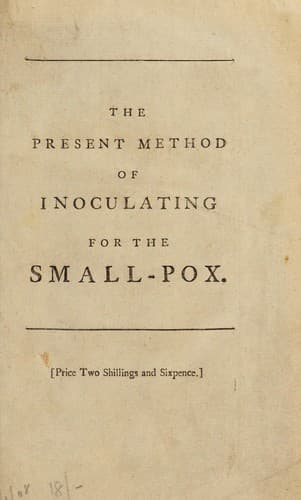
The Present Method of Inoculating for the Small-Pox: To which are added, some experiments, instituted with a view to discover the effects of a similar treatment in the natural small-poxDimsdale, Thomas
History
The Present Method of Inoculating for the Small-Pox: To which are added, some experiments, instituted with a view to discover the effects of a similar treatment in the natural small-pox
Dimsdale, Thomas
Smallpox -- Vaccination -- Early works to 1800
it, which I concluded would be at least three or four hours from that
time.
Next morning, on visiting him, I was told that the purge had operated
four times, that he found himself considerably relieved, both in his
head and back, and had rested better than any time since he had been
taken ill. The eruption proceeded slowly; but many more pustules now
appeared in his face, and other parts, than before; he kept abroad,
and his complaints continued wearing off. Next morning I found him
quite easy; he was pretty full of a distinct pock, and from this time
all went on well, without having occasion to take any more medicines.
POSTSCRIPT.
Many instances might be produced of unjust charges against Inoculation,
alledged by those who have opposed the practice: but I should not at
this time, and in this country, where the prejudices are pretty well
removed, publish any case of the following kind, if the inadvertence of
a translator had not made it necessary, in defence of my own character.
Dr. Baylies, an ingenious and learned English physician, had been
called from Dresden to Berlin, in 1774, to inoculate some families
of persons of condition; and the King of Prussia so far approved the
practice, as to appoint him his physician.
After the most perfect success with several patients, a child who had
been inoculated by him, was, about two months after, seized with
a distemper which proved mortal, and the physicians who attended,
asserted that the child died of the small-pox.
In vindication of his own character, and the practice of Inoculation,
Dr. Baylies had the case of this child stated, and copies of it were
transmitted to Dr. Watson, Dr. Archer, and myself, requesting our
separate opinions.[7]
[7] Our opinions were essentially the same, but I neither thought it
right to take the liberty, nor would it be of any importance to the
matter in question to insert those of the other gentlemen.
The ungenerous treatment Dr. Baylies met with in this, and other
respects, induced him to publish a tract on the occasion, in French, in
which our opinions were inserted; and he was so obliging as to send me
one of them.[8]
[8] Memoire concernant l’etat de l’Inoculation de la petite Verole à
Berlin, &c.--A Dresde 1776.
I was greatly surprized to find what I had written, so erroneously
translated, as to misrepresent my meaning in a most essential point.
I therefore wrote to Dr. Baylies, and complained of the injury,
requesting that he would endeavour to do me justice, in the manner he
thought most effectual.
Notwithstanding this was generously complied with by Dr. Baylies, as
far as he was able, I have reason to think, that some of the first
copies are dispersed, and remain uncorrected; which I hope will be
deemed a sufficient reason for publishing the following correspondence.
CASE.
Public-domain text, read in full here on John Shaqi.
Reviews
Reviews
No reviews yet
Be the first to share your thoughts on this work.
Elsewhere in the archive
Join the Discussion
Join the discussion
Sign in to leave a comment or review.
Sign InorCreate an account