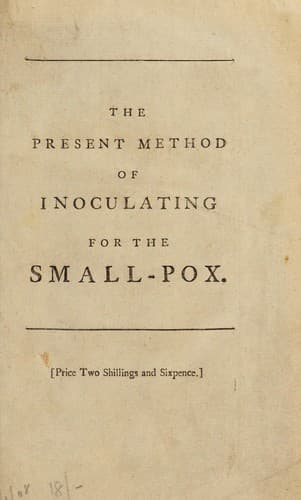
The Present Method of Inoculating for the Small-Pox: To which are added, some experiments, instituted with a view to discover the effects of a similar treatment in the natural small-poxDimsdale, Thomas
History
The Present Method of Inoculating for the Small-Pox: To which are added, some experiments, instituted with a view to discover the effects of a similar treatment in the natural small-pox
Dimsdale, Thomas
Smallpox -- Vaccination -- Early works to 1800
Monday the 14th of the month, and 15th of the illness, early in the
morning the attendant physician again examined the eruptions, and said
that he not only found their number great, but that many of them on
the back were broke and subsided while there were others under the
skin perceptible to the touch; and a very few on the face and neck,
though flat, were round and reddish in their circumference, and white
on their tops, so resembling eruptions of the small-pox, that he
suspected the distemper could be no other: to put the matter out of
doubt, the physician, that had inoculated the child, was called in;
who, when he came, observed two or three flat eruptions on the face, to
be round, edged with a reddish colour, and whitish on the top, as is
above described; but on uncovering the body, and examining the rest,
the chief of which were situated on the back, he looked on them to have
more the appearance of burns or scalds than the small-pox. They were of
irregular forms, like flaccid and transparent vesicles, implete with
a reddish watry fluid, with a visible blackness underneath. He could
not from their appearance, considered from the time of their eruption,
and the early fluidity of their contents after they appeared, see any
reason to think them at all variolous, especially as the child had so
evidently had the disease from inoculation under his own eyes.
Tuesday the 15th of the month, and 16th of the disease, the physician,
who had inoculated the child, called again to see him, when he was
informed, that he had totally lost all power of swallowing, and that it
was suspected to arise from pustules in the throat. He then went to the
child’s bedside, when he not only found many of the before described
bladdery eruptions broken, and their water discharged, but all those
that were not so, more flaccid and empty than the day before.
Wednesday the 16th of the month, and 17th of the disease, there
was very little or no observable change in the morning from the
circumstances which had attended the preceding day; yet some glimmering
hope was conceived of the child’s recovery; but about two in the
afternoon, the melancholy scene was closed by an easy death.
Thursday the 17th of the month, and the morrow after the child’s
death, the physician that had inoculated the child called again, to
inquire of the father if any thing more, that was material, had been
observed between the time he had last seen the child, and the hour
of his death, when he told him that there had not, but that since his
death the corpse had been inspected and opened, in the presence of
four eminent gentlemen of the faculty in Berlin, and that it had been
reported to him as follows.
That the external spots, which had been covered with the before
described bladders, had many of them a blackish, or gangrenous
appearance under the skin; while others that were extremely small,
round and flat, seemed to have in them a small quantity of unconcocted
matter.
Public-domain text, read in full here on John Shaqi.
Reviews
Reviews
No reviews yet
Be the first to share your thoughts on this work.
Elsewhere in the archive
Join the Discussion
Join the discussion
Sign in to leave a comment or review.
Sign InorCreate an account