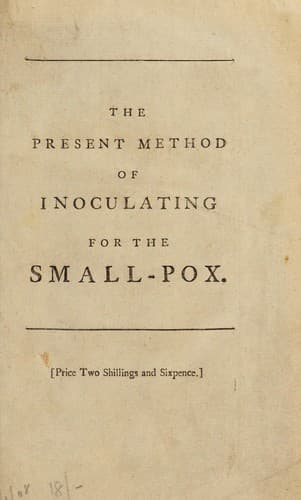
The Present Method of Inoculating for the Small-Pox: To which are added, some experiments, instituted with a view to discover the effects of a similar treatment in the natural small-poxDimsdale, Thomas
History
The Present Method of Inoculating for the Small-Pox: To which are added, some experiments, instituted with a view to discover the effects of a similar treatment in the natural small-pox
Dimsdale, Thomas
Smallpox -- Vaccination -- Early works to 1800
The appearance of the spots, is such as might be reasonably expected on
any person who died of a malignant fever. Dry scabs frequently remain
on the inoculated parts, for some months after the disease.
T. DIMSDALE.
To Dr. Baylies, Physician and Privy-Counsellor to his Prussian
Majesty at Berlin.
London, March 10, 1777.
Dear Sir,
Please to accept my thanks for a very polite letter and a book, both
which I received from my learned friend, Dr. Watson. But I am greatly
chagrined to find, on the perusal of the French translation of my
answers to the queries, that by the insertion of words, not to be found
in what I wrote, not only the sense of my answer is perverted, but I am
made to speak what is not true, and to give an opinion contrary to my
own sentiments, and the experience of every one in the least acquainted
with the small-pox.
What follows will convince you, Sir, that my complaint is well founded,
and I confide in your honour, for taking the most effectual steps to
prevent the injury my character would sustain, if the mistake should
not be rectified.
You will please to observe, that at the conclusion of the case
transmitted to me, there were three queries, to each of which I
gave distinct answers. The third query is: “Or were the _pustulary
eruptions_ that shewed themselves on the 12th day of the disease, a
critical discharge of a putrid, or other kind of fever?” In my answer,
having first remarked that the patient passed through the inoculated
disease in a regular manner, I say in reply to the above-mentioned
query.
“After which he was seized with a disease, that I have not the least
doubt was a fever of the putrid kind; but I do not think that _the
pustulary eruptions_ can with propriety be deemed critical, as _they
did not terminate_ the disease: I rather esteem them to have been marks
or tokens of great malignity and anger.”
The French translation stands thus.
Q. “Ou les pustules qui ont paru le 12me jour de la maladie ont elles
été l’evacuation critique d’une fievre putride, ou d’une autre espece
de fievre?”
Reponse. “Ce n’est qu’au bout de ce tems qu’il a été attaqué d’une
maladie, que je crois, sans balancer, avoir été une espece de fievre
putride. Il ne faut cependant pas, selon moi, considerer _les pustules
de la petite vérole_, comme une crise, parce _qu’elle ne leve pas_ la
maladie; au contraire je les regarde comme les marques d’une grande
malignité et d’un grand danger, ouse trouve le patient.”
The perusal of the above will certainly satisfy you of the justness of
my complaint, and I shall wait with impatience for your answer, which
I make no doubt will be such as is consistent with your honour and
character.
Public-domain text, read in full here on John Shaqi.
Reviews
Reviews
No reviews yet
Be the first to share your thoughts on this work.
Elsewhere in the archive
Join the Discussion
Join the discussion
Sign in to leave a comment or review.
Sign InorCreate an account