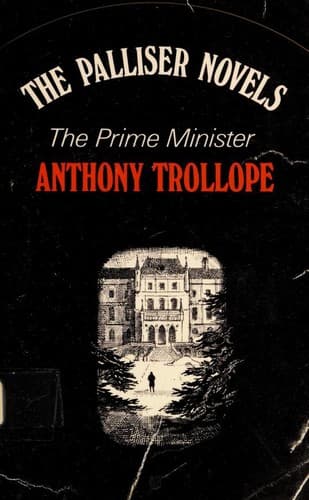
London (England) -- Fiction; Palliser, Plantagenet (Fictitious character) -- Fiction; Political fiction; Prime ministers -- Fiction
"She'd only show it her father. She is so perverse that I sometimes
feel inclined to say that I'll have nothing further to do with her."
"You'll give her a message at any rate?"
"Yes,--I can do that;--because I can do it in a way that won't seem
to make it important."
"But I want my message to be very important. Tell her that I've seen
her father, and have offered to explain all my affairs to him,--so
that he may know that there is nothing to fear on her behalf."
"It isn't any thought of money that is troubling him."
"But tell her what I say. He, however, would listen to nothing. Then
I assured him that no consideration on earth would induce me to
surrender her, and that I was as sure of her as I am of myself. Tell
her that;--and tell her that I think she owes it to me to say one
word to me before she goes into the country."
CHAPTER XV
Arthur Fletcher
It may, I think, be a question whether the two old men acted wisely
in having Arthur Fletcher at Wharton Hall when Emily arrived there.
The story of his love for Miss Wharton, as far as it had as yet gone,
must be shortly told. He had been the second son, as he was now the
second brother, of a Herefordshire squire endowed with much larger
property than that belonging to Sir Alured. John Fletcher, Esq., of
Longbarns, some twelve miles from Wharton, was a considerable man in
Herefordshire. This present squire had married Sir Alured's eldest
daughter, and the younger brother had, almost since they were
children together, been known to be in love with Emily Wharton. All
the Fletchers and everything belonging to them were almost worshipped
at Wharton Hall. There had been marriages between the two families
certainly as far back as the time of Henry VII, and they were
accustomed to speak, if not of alliances, at any rate of friendships,
much anterior to that. As regards family, therefore, the pretensions
of a Fletcher would always be held to be good by a Wharton. But this
Fletcher was the very pearl of the Fletcher tribe. Though a younger
brother, he had a very pleasant little fortune of his own. Though
born to comfortable circumstances, he had worked so hard in his young
days as to have already made for himself a name at the bar. He was
a fair-haired, handsome fellow, with sharp, eager eyes, with an
aquiline nose, and just that shape of mouth and chin which such men
as Abel Wharton regarded as characteristic of good blood. He was
rather thin, about five feet ten in height, and had the character of
being one of the best horsemen in the county. He was one of the most
popular men in Herefordshire, and at Longbarns was almost as much
thought of as the squire himself. He certainly was not the man to be
taken, from his appearance, for a forlorn lover. He looked like one
of those happy sons of the gods who are born to success. No young
man of his age was more courted both by men and women. There was no
one who in his youth had suffered fewer troubles from those causes
Public-domain text, read in full here on John Shaqi.
Reviews
Reviews
No reviews yet
Be the first to share your thoughts on this work.
Elsewhere in the archive
Join the Discussion
Join the discussion
Sign in to leave a comment or review.
Sign InorCreate an account