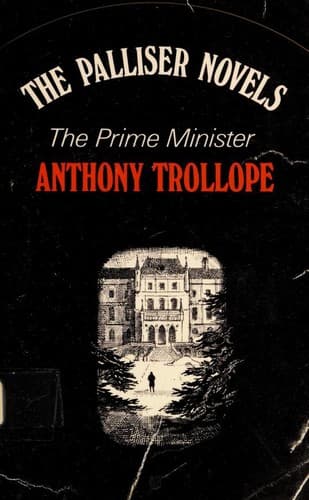
London (England) -- Fiction; Palliser, Plantagenet (Fictitious character) -- Fiction; Political fiction; Prime ministers -- Fiction
himself about the place? Then he went farther afield from the house
and came across more and more men. A great ha-ha fence had been made,
enclosing on three sides a large flat and turfed parallelogram of
ground, taken out of the park and open at one end to the gardens,
containing, as he thought, about an acre. "What are you doing this
for?" he said to one of the labourers. The man stared at him, and
at first seemed hardly inclined to make him an answer. "It be for
the quality to shoot their bows and harrows," he said at last, as
he continued the easy task of patting with his spade the completed
work. He evidently regarded this stranger as an intruder who was not
entitled to ask questions, even if he were permitted to wander about
the grounds.
From one place he went on to another and found changes, and new
erections, and some device for throwing away money everywhere. It
angered him to think that there was so little of simplicity left in
the world that a man could not entertain his friends without such a
fuss as this. His mind applied itself frequently to the consideration
of the money, not that he grudged the loss of it, but the spending of
it in such a cause. And then perhaps there occurred to him an idea
that all this should not have been done without a word of consent
from himself. Had she come to him with some scheme for changing
everything about the place, making him think that the alterations
were a matter of taste or of mere personal pleasure, he would
probably have given his assent at once, thinking nothing of the
money. But all this was sheer display. Then he walked up and saw the
flag waving over the Castle, indicating that he, the Lord Lieutenant
of the County, was present there on his own soil. That was right.
That was as it should be, because the flag was waving in compliance
with an acknowledged ordinance. Of all that properly belonged to
his rank and station he could be very proud, and would allow no
diminution of that outward respect to which they were entitled. Were
they to be trenched on by his fault in his person, the rights of
others to their enjoyment would be endangered, and the benefits
accruing to his country from established marks of reverence would
be imperilled. But here was an assumed and preposterous grandeur
that was as much within the reach of some rich swindler or of some
prosperous haberdasher as of himself,--having, too, a look of raw
newness about it which was very distasteful to him. And then, too,
he knew that nothing of all this would have been done unless he had
become Prime Minister. Why on earth should a man's grounds be knocked
about because he becomes Prime Minister? He walked on arguing this
within his own bosom, till he had worked himself almost up to anger.
It was clear that he must henceforth take things more into his
own hands, or he would be made to be absurd before the world.
Indifference he knew he could bear. Harsh criticism he thought he
could endure.
Public-domain text, read in full here on John Shaqi.
Reviews
Reviews
No reviews yet
Be the first to share your thoughts on this work.
Elsewhere in the archive
Join the Discussion
Join the discussion
Sign in to leave a comment or review.
Sign InorCreate an account