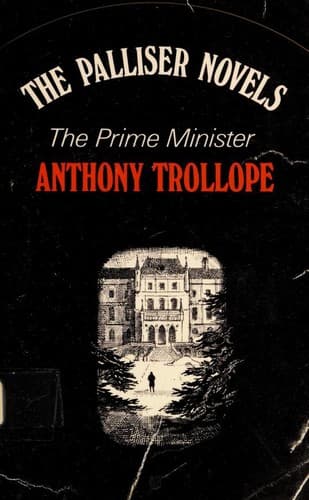
London (England) -- Fiction; Palliser, Plantagenet (Fictitious character) -- Fiction; Political fiction; Prime ministers -- Fiction
When she was alone she at once burst into tears; but she soon dried
her eyes, and putting down her work, settled herself to think of it
all. What did it mean? Why was he thus changed to her? Could it be
that he was the same Ferdinand to whom she had given herself without
a doubt as to his personal merit? Every word that he had spoken since
she had shown him the letter from Arthur Fletcher had been injurious
to her, and offensive. It almost seemed as though he had determined
to show himself to be a tyrant to her, and had only put off playing
the part till the first convenient opportunity after their honeymoon.
But through all this, her ideas were loyal to him. She would obey him
in all things where obedience was possible, and would love him better
than all the world. Oh yes;--for was he not her husband? Were he
to prove himself the worst of men she would still love him. It had
been for better or for worse; and as she had repeated the words to
herself, she had sworn that if the worst should come, she would still
be true.
But she could not bring herself to say that Arthur Fletcher had
behaved badly. She could not lie. She knew well that his conduct had
been noble and generous. Then unconsciously and involuntarily,--or
rather in opposition to her own will and inward efforts,--her mind
would draw comparisons between her husband and Arthur Fletcher. There
was some peculiar gift, or grace, or acquirement belonging without
dispute to the one, and which the other lacked. What was it? She had
heard her father say when talking of gentlemen,--of that race of
gentlemen with whom it had been his lot to live,--that you could not
make a silk purse out of a sow's ear. The use of the proverb had
offended her much, for she had known well whom he had then regarded
as a silk purse and whom as a sow's ear. But now she perceived that
there had been truth in all this, though she was as anxious as ever
to think well of her husband, and to endow him with all possible
virtues. She had once ventured to form a doctrine for herself, to
preach to herself a sermon of her own, and to tell herself that this
gift of gentle blood and of gentle nurture, of which her father
thought so much, and to which something of divinity was attributed
down in Herefordshire, was after all but a weak, spiritless quality.
It could exist without intellect, without heart, and with very
moderate culture. It was compatible with many littlenesses and with
many vices. As for that love of honest, courageous truth which her
father was wont to attribute to it, she regarded his theory as based
upon legends, as in earlier years was the theory of the courage, and
constancy, and loyalty of the knights of those days. The beau ideal
of a man which she then pictured to herself was graced, first with
intelligence, then with affection, and lastly with ambition. She knew
no reason why such a hero as her fancy created should be born of
lords and ladies rather than of working mechanics, should be English
Public-domain text, read in full here on John Shaqi.
Reviews
Reviews
No reviews yet
Be the first to share your thoughts on this work.
Elsewhere in the archive
Join the Discussion
Join the discussion
Sign in to leave a comment or review.
Sign InorCreate an account