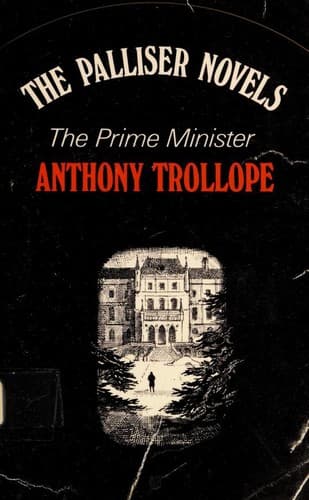
London (England) -- Fiction; Palliser, Plantagenet (Fictitious character) -- Fiction; Political fiction; Prime ministers -- Fiction
"Of course it's complicated," continued Arthur, "but when you come to
look into it it comes out clear enough. It is one of the instances
of the omnipotence of capital. Parliament can do such a thing, not
because it has any creative power of its own, but because it has the
command of unlimited capital." Mr. Wharton looked at him, sighing
inwardly as he reflected that unrequited love should have brought a
clear-headed young barrister into mists so thick and labyrinths so
mazy as these. "A very good beefsteak indeed," said Arthur. "I don't
know when I ate a better one. Thank you, no;--I'll stick to the
claret." Mr. Wharton had offered him Madeira. "Claret and brown meat
always go well together. Pancake! I don't object to a pancake. A
pancake's a very good thing. Now would you believe it, sir; they
can't make a pancake at the House."
"And yet they sometimes fall very flat too," said the lawyer, making
a real lawyer's joke.
"It's all in the mixing, sir," said Arthur, carrying it on. "We've
mixture enough just at present, but it isn't of the proper sort;--too
much of the flour, and not enough of the egg."
But Mr. Wharton had still something to say, though he hardly knew how
to say it. "You must come and see us in the Square after a bit."
"Oh;--of course."
"I wouldn't ask you to dine there to-day, because I thought we should
be less melancholy here;--but you mustn't cut us altogether. You
haven't seen Everett since you've been in town?"
"No, sir. I believe he lives a good deal,--a good deal with--Mr.
Lopez. There was a little row down at Silverbridge. Of course it will
wear off, but just at present his lines and my lines don't converge."
"I'm very unhappy about him, Arthur."
"There's nothing the matter?"
"My girl has married that man. I've nothing to say against him;--but
of course it wasn't to my taste; and I feel it as a separation. And
now Everett has quarrelled with me."
"Quarrelled with you!"
Then the father told the story as well as he knew how. His son
had lost some money, and he had called his son a gambler;--and
consequently his son would not come near him. "It is bad to lose them
both, Arthur."
"That is so unlike Everett."
"It seems to me that everybody has changed,--except myself. Who would
have dreamed that she would have married that man? Not that I have
anything to say against him except that he was not of our sort. He
has been very good about Everett, and is very good about him. But
Everett will not come to me unless I--withdraw the word;--say that I
was wrong to call him a gambler. That is a proposition that no son
should make to a father."
"It is very unlike Everett," repeated the other. "Has he written to
that effect?"
"He has not written a word."
"Why don't you see him yourself, and have it out with him?"
"Am I to go to that club after him?" said the father.
Public-domain text, read in full here on John Shaqi.
Reviews
Reviews
No reviews yet
Be the first to share your thoughts on this work.
Elsewhere in the archive
Join the Discussion
Join the discussion
Sign in to leave a comment or review.
Sign InorCreate an account