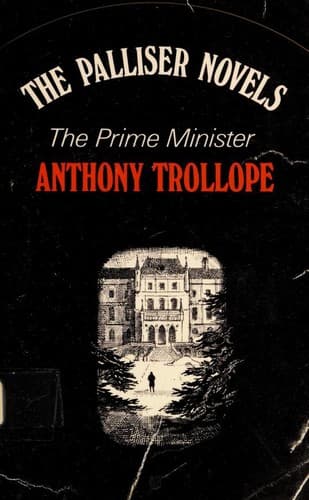
London (England) -- Fiction; Palliser, Plantagenet (Fictitious character) -- Fiction; Political fiction; Prime ministers -- Fiction
"Oh, the old story;--that you were like Martha, busying yourself
about many things."
"Why shouldn't I busy myself about many things? It is a pity, Captain
Gunner, that some of you men have not something to busy yourselves
about." All this was unpleasant. She could on such an occasion make
up her mind to drop any Captain Gunner who had ventured to take too
much upon himself; but she felt that in the efforts which she had
made after popularity, she had submitted herself to unpleasant
familiarities;--and though persistent in her course, she was still
angry with herself.
When she had begun her campaign as the Prime Minister's wife, one
of her difficulties had been with regard to money. An abnormal
expenditure became necessary, for which her husband's express
sanction must be obtained, and steps taken in which his personal
assistance would be necessary;--but this had been done, and there
was now no further impediment in that direction. It seemed to be
understood that she was to spend what money she pleased. There had
been various contests between them, but in every contest she had
gained something. He had been majestically indignant with her in
reference to the candidature at Silverbridge,--but, as is usual with
many of us, had been unable to maintain his anger about two things
at the same time. Or, rather, in the majesty of his anger about her
interference, he had disdained to descend to the smaller faults of
her extravagance. He had seemed to concede everything else to her,
on condition that he should be allowed to be imperious in reference
to the borough. In that matter she had given way, never having
opened her mouth about it after that one unfortunate word to Mr.
Sprugeon. But, having done so, she was entitled to squander her
thousands without remorse,--and she squandered them. "It is your
five-and-twenty thousand pounds, my dear," she once said to Mrs.
Finn, who often took upon herself to question the prudence of all
this expenditure. This referred to a certain sum of money which
had been left by the old Duke to Madame Goesler, as she was then
called,--a legacy which that lady had repudiated. The money had,
in truth, been given away to a relation of the Duke's by the joint
consent of the lady and of the Duke himself, but the Duchess was
pleased to refer to it occasionally as a still existing property.
"My five-and-twenty thousand pounds, as you call it, would not go
very far."
"What's the use of money if you don't spend it? The Duke would go
on collecting it and buying more property, which always means more
trouble,--not because he is avaricious, but because for the time
that comes easier than spending. Supposing he had married a woman
without a shilling, he would still have been a rich man. As it is,
my property was more even than his own. If we can do any good by
spending the money, why shouldn't it be spent?"
"If you can do any good!"
Public-domain text, read in full here on John Shaqi.
Reviews
Reviews
No reviews yet
Be the first to share your thoughts on this work.
Elsewhere in the archive
Join the Discussion
Join the discussion
Sign in to leave a comment or review.
Sign InorCreate an account