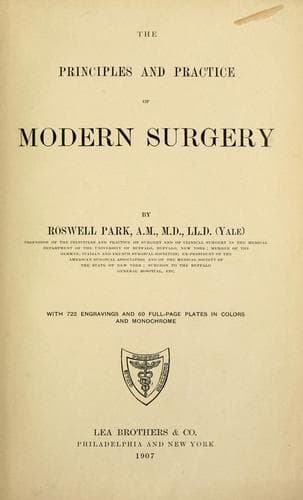
The principles and practice of modern surgeryPark, Roswell
Science
The principles and practice of modern surgery
Park, Roswell
Surgery
C. =Constitutional Causes.=--Among these are to be mentioned
particularly that symptom-complex ordinarily known as _diabetes_ or
_glycosuria_. This means a depraved condition of the system in which
gangrene is threatened or permitted under circumstances which otherwise
would have little or no disastrous effect. Thus _diabetic gangrene_
has come to be one of the recognized manifestations of the general
disease. That the trophic nerves have a more or less pronounced effect
in determining gangrene in certain cases seems to be now quite well
established. It is well known how quickly _bed-sores_ form after
injuries to the spine, while in certain nervous affections a minimum of
friction of the skin may determine its death, particularly about the
labia or scrotum. It is said that the insane, when made to sleep by
chloral, may develop decubitus from pressure in a single night. There
is also a well-known form of _symmetrical gangrene_, known sometimes
as _Raynaud’s disease_, which is characterized by symmetry of lesions
and absence of definite pathological changes (Figs. 14 and 15). The
so-called _digiti mortui_, or _dead fingers_, and _erythromelalgia_ are
examples of this character. A condition almost leading up to gangrene,
but perhaps not absolutely terminating in such a way, has been known
as _local asphyxia_, which seems to be a condition of arterial spasm
with venous congestion and slight edema. While the aged will often
recover from a legitimate surgical operation without disturbance, it
is, nevertheless, true that senile gangrene commencing in the toes has
for its cause some very trifling injury or lesion, such, _e. g._, as
paring of a corn, or the like. This shows a weakened local and general
resistance, as well as the wisdom of redoubling aseptic precautions in
operations upon such patients.
As constitutional causes also should be included the deleterious
effects of certain drugs, particularly ergot, mercury, and phosphorus.
D. =Infectious Causes.=--In the instances already mentioned reference
to the infectious microörganisms has been avoided. There remain
to be considered types of gangrene due to the activity of certain
microörganisms--_hospital gangrene_, _phlegmonous erysipelas_,
_malignant edema_, _gangrenous emphysema_, _noma_, _ainhum_, etc.
Public-domain text, read in full here on John Shaqi.
Reviews
Reviews
No reviews yet
Be the first to share your thoughts on this work.
Elsewhere in the archive
Join the Discussion
Join the discussion
Sign in to leave a comment or review.
Sign InorCreate an account