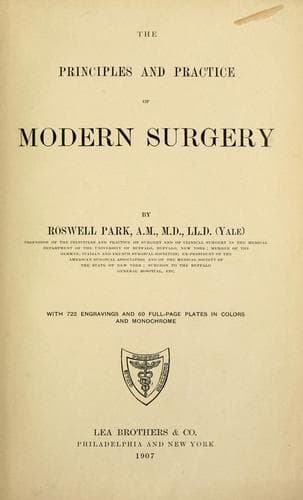
The principles and practice of modern surgeryPark, Roswell
Science
The principles and practice of modern surgery
Park, Roswell
Surgery
_Noma_, known also as _gangrenous stomatitis_, _cancrum oris_, and
_gangræna oris_, is a term applied to a form of tissue necrosis
affecting the cheeks or parts about the face of young children,
occurring frequently as a complication of the exanthemata. A similar
condition occasionally involves the external genitals. From the fact
that it seldom passes across the middle line, it has been regarded
by some as of neurotic origin. Naturally bacteria are always found
in the decomposing tissues; but whether there as cause or as result
is not yet established. The probability is, however, that we have
to deal with a specific form of infection. The loss of substance is
usually so great as to determine complete perforation of the cheek, so
that the jaw bones may be laid bare. The gums and alveolar processes
also frequently share in the process, and the teeth occasionally drop
out. Death of tissue is rapid, and septic infection may accompany
it to such an extent as to cause the death of the patient in a few
days. While most vigorous measures are necessary for combating it,
the patients are often so reduced as to preclude the possibility of
doing much, and death is the termination of noma. Free incision, even
complete excision, is called for, perhaps with combined resort to
the actual cautery or such remedies as bromine (strong or diluted).
Antistreptococcic serum has also been used with success. Obviously it
must be used early if success is expected. Should patients recover,
there is extensive deformity as the result of cicatricial contraction.
Along the coast of Africa and in the West Indies there occurs among the
negroes a peculiar gangrenous affection of the toes known as _ainhum_.
This may assume either the moist or the dry type of gangrene, but the
result is gradual separation of the part, usually by the dry process,
as if it had been strangulated by a ligature. The disease is slow and
may extend over ten years. The cause is unknown.
Finally, gangrene is the termination of the infectious process in
several other zymotic diseases, among the best illustrations being that
afforded by _diphtheria_. The formation of diphtheritic ulcers in the
mouth and the vulva, about the eyes and elsewhere, as the result of
separation of sloughs, is too frequent to pass unnoticed, yet at the
same time does not essentially differ from the separation of sloughs
due to any other specific cause. All these acute zymotic diseases,
therefore, need to be regarded as among the possible causes of gangrene
by infection of tissues.
The _symmetrical gangrene_, often paroxysmal, affecting the fingers
and toes, described by Raynaud and often called by his name, is due
to vasomotor spasm, and is accompanied by neuralgia and sensory
disturbances, with coldness of the part and discoloration suggestive of
impending gangrene. (See above.)
Public-domain text, read in full here on John Shaqi.
Reviews
Reviews
No reviews yet
Be the first to share your thoughts on this work.
Elsewhere in the archive
Join the Discussion
Join the discussion
Sign in to leave a comment or review.
Sign InorCreate an account