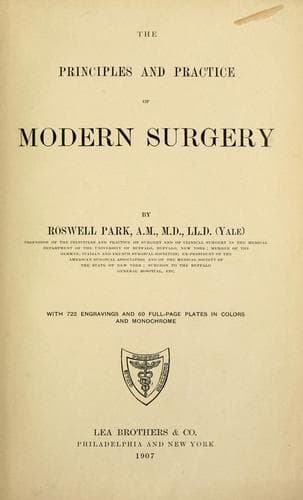
The principles and practice of modern surgeryPark, Roswell
Science
The principles and practice of modern surgery
Park, Roswell
Surgery
=Treatment.=--_Threatening gangrene_ should be attacked and the cause
removed. Threatening bed-sores may be avoided by equalizing surface
pressure, which can be done with the water-bed; by protecting the skin
or by stimulating and toughening it with alcoholic and astringent
lotions; by frequent changes of position; by attention to the heart,
which should be stimulated to a point that may make it capable of
forcing or distributing blood equally over the entire body. So,
too, with limbs which are enveloped in dressings or splints; it is
well to leave exposed the tips of the toes or fingers in order that
discoloration of the same may be recognized and the threatening
disasters averted. Local gangrene as the result of pressure by tumors,
aneurysms, etc., cannot always be averted.
For gangrene there is but one relief, the _removal of the dead and
dying tissue_. The method and location of the operation must be
determined by the general character of the cause. For a case of acute
traumatic gangrene amputation at the nearest point of election above
the injury will often suffice. In case of gangrene from frostbite the
tissues in the neighborhood of the line of demarcation are so affected
or their vitality so compromised that to separate the tissues along
the lines at which nature is endeavoring to remove them is not enough,
and to go an inch or so above this line is to operate in tissues which
bleed readily and heal badly. Consequently it is often advisable to
select a point at some distance above. It is especially in diabetic
and senile gangrene that surgeons have laid down the rule that if
_amputation_ is done at all it must be _high_. For gangrene of the toe,
as the result of disease of the vessels, it is best to amputate above
the ankle; whereas if any greater portion of the foot is threatened,
amputation should take place above the knee. The tibial arteries have
been found so brittle as to snap under a ligature, and the femorals
so disorganized as to require handling and ligating with the greatest
caution. These high amputations are therefore necessitated by the
condition of the vessel walls. While amputation for traumatic and
acute cases is, in the majority of instances, if not too long delayed,
successful in saving life, in the senile and particularly in the
diabetic forms it is, in the majority of cases, a disappointment.
PART II.
SURGICAL DISEASES.
CHAPTER VI.
AUTO-INFECTION, ESPECIALLY IN SURGICAL PATIENTS.
Public-domain text, read in full here on John Shaqi.
Reviews
Reviews
No reviews yet
Be the first to share your thoughts on this work.
Elsewhere in the archive
Join the Discussion
Join the discussion
Sign in to leave a comment or review.
Sign InorCreate an account