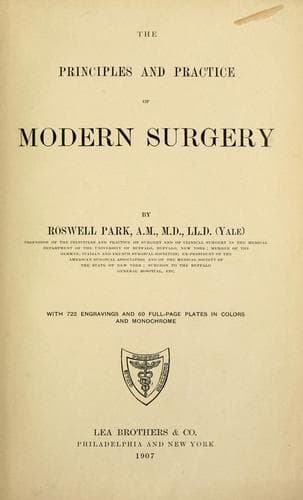
The principles and practice of modern surgeryPark, Roswell
Science
The principles and practice of modern surgery
Park, Roswell
Surgery
A determination of indol and indican is often of the greatest value,
both in determining the extent of infection and the presence of pus.
Indol is set free under the following circumstances: (_a_) Suppuration
in a closed cavity. (_b_) Continued suppuration in a cavity with
an outlet. (_c_) Ulceration or necrosis of tissue. The degree of
indicanuria will depend on the length of time pus has been present,
the possibility of absorption from the tissues surrounding it, and its
degree. When pus is fully formed in a serous sac the indican reaction
becomes intense according to the length of time pus has been present.
This is particularly true in the empyemas of childhood. In continued
suppuration with a free outlet the production of indol will be great;
but the amount finally eliminated will depend upon the character of the
surrounding tissue. When solid tissue, like bone, becomes affected,
the elimination of indol is intense. Rapid biogenic degeneration of
tissue causes an increased amount of indol to be deposited in the
liver, and it is possible at postmortem, by simple extraction with
absolute alcohol, to take from the liver this excess deposit in the
shape of its oxidation product, indigo blue. Lardaceous degeneration
is characterized by marked and persistent elimination of indol, which
seems to be a product of tyrosin. It occurs frequently in the liver, in
which indol is notably deposited. Its primary factor is deposited by
the blood, in which latter indol circulates and is oxidized. Lardaceous
material gives a red or blue color with oxidizing agents, which latter
yield with indol an indigo red or blue.
Public-domain text, read in full here on John Shaqi.
Reviews
Reviews
No reviews yet
Be the first to share your thoughts on this work.
Elsewhere in the archive
Join the Discussion
Join the discussion
Sign in to leave a comment or review.
Sign InorCreate an account