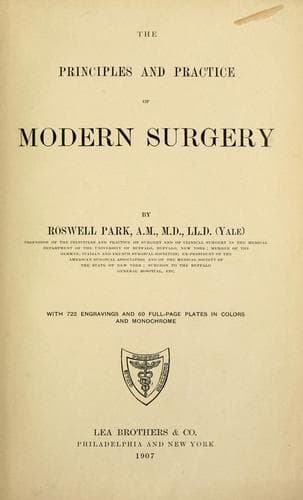
The principles and practice of modern surgeryPark, Roswell
Science
The principles and practice of modern surgery
Park, Roswell
Surgery
The _general treatment_ of septicemia is, in the main, _stimulant_ and
_tonic_. Fever is not to be treated with arterial sedatives nor often
with antipyretics. It is a symptom of poisoning, and its too prompt
suppression prevents both the recognition of the intoxication and the
measure of its degree. Pyrexia then is best combated with cool sponge
baths and stimulant measures of a general character. The principal
reliance must be upon _nutrition_ and _stimulants_. Assimilation
may be impaired when gastro-intestinal catarrh is as prominent a
feature as it is in many of these cases. Consequently the simplest
and most assimilable food, often that which is predigested, should be
administered. Milk, eggs, beef peptonoids, and fruits are among the
most appropriate. The best stimulants and tonics are _alcohol_ and
_strychnine_. Strychnine is preferably administered hypodermically in
doses of ¹⁄₂₅ grain from two to four times a day. Heart depression is
best combated by this measure, or by _quinine_ in large doses, while
digitalis and atropine may be added. For internal use _alcohol_ is,
_par excellence_, _the remedy_. This is administered in doses only to
be measured by their effect. In fact, the administration of alcohol
in these cases is a matter of _effect_, and _not of dosage_. Aside
from these measures the intestinal antiseptics should be administered,
among these being corrosive sublimate, ¹⁄₁₀₀ grain, every three or four
hours, salol in large doses, bismuth salicylate, or naphthalin--any
or all of these in connection with powdered charcoal. Intestinal pain
and frequency of stool can be more or less controlled by opium, while
disinfection of the alimentary canal is only to be accomplished by the
above remedies, in connection with flushing of the colon with saturated
boric acid solution or something of that kind. Pain is to be controlled
by morphine administered subcutaneously.
No special attention need be given to the so-called _septicopyemia_. It
represents a mixed condition of septic intoxication, local infection,
and destruction, with metastatic abscess, and is a term appropriately
applied to cases which combine the significant features of each type.
PYEMIA.
The derivation of the term pyemia, which came into general use in 1828,
is misleading. Although septic fever always accompanies suppuration, it
is not certain that pus as such circulates in the blood, as the term
pyemia implies, the error having arisen originally from mistaking the
contents of breaking-down thrombi for pus from ordinary sources. While
a recognition of the etiology of the disease is new, the disease itself
has been recognized for many centuries.
Public-domain text, read in full here on John Shaqi.
Reviews
Reviews
No reviews yet
Be the first to share your thoughts on this work.
Elsewhere in the archive
Join the Discussion
Join the discussion
Sign in to leave a comment or review.
Sign InorCreate an account