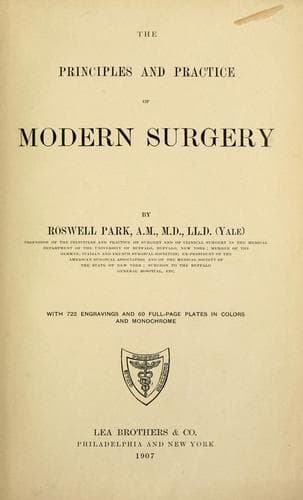
The principles and practice of modern surgeryPark, Roswell
Science
The principles and practice of modern surgery
Park, Roswell
Surgery
Whether the disease proceeds from an injury or not, the
_constitutional_ symptoms vary but little. There is usually a period of
_malaise_ with _nausea_, followed by alimentary disturbance, coating
of the tongue, elevation of _temperature_, sometimes with occurrence
of _chill_. Complaint of pain or unpleasant sensation will lead to
examination of the area involved, when the above symptoms will be
noted, with evidences of _lymphangitis_ and enlargement of lymph nodes.
When chill occurs it is followed by pyrexia. Temperature fluctuates,
with a tendency to assume the remittent type. When the disease subsides
spontaneously it is by a gradual process of betterment and subsidence
of temperature. In other instances the constitutional symptoms assume
more or less of the _septicemic_ or _typhoid_ type, and it is seen that
the patient’s condition is practically one of mild septicemia, which
often proves fatal.
When the disease assumes the _phlegmonous_ type the constitutional
symptoms become more and more typhoidal and the septicemia becomes most
pronounced. Locally exudation goes on to the point of threatening,
even of actual, gangrene, unless tension is relieved by incisions.
Pain is usually intense, partly because of confined exudates beneath
resisting structures. More or less rapidly the local and constitutional
signs of pus formation are noted, and unless these are observed and
acted upon early there will not only be suppuration, but more or less
actual gangrene, so that not only pus, but sloughs of tissue will be
discharged through the incision, or will, when this is delayed, make
their escape by death of overlying textures.
In all _phlegmonous_ cases there is practically coincidence of
septicemia, already described, and of the local appearances above
noted. In proportion to the extent of the lesion in these phlegmonous
cases, and failure to afford relief, will be the opportunity for septic
intoxication.
The mucous membrane does not always escape, and even in the nose, the
pharynx, the vagina, and the rectum a distinctive erysipelatous lesion
may be found. The disease may travel from the pharynx through the nose
and involve the face, or through the Eustachian tube to the ear and
thence to the scalp, or _vice versa_. _Erysipelatous laryngitis_ is to
be feared on account of edema of the glottis, which would soon be fatal
unless overcome by intubation or tracheotomy. An infectious exudation
into the lungs is also known to follow erysipelas, and has been
considered an _erysipelatous pneumonia_. The cellular tissue of the
orbits may also be involved, when abscesses will occur, which should
be opened early; the parotid and other salivary glands may become
involved, usually in suppuration.
Public-domain text, read in full here on John Shaqi.
Reviews
Reviews
No reviews yet
Be the first to share your thoughts on this work.
Elsewhere in the archive
Join the Discussion
Join the discussion
Sign in to leave a comment or review.
Sign InorCreate an account