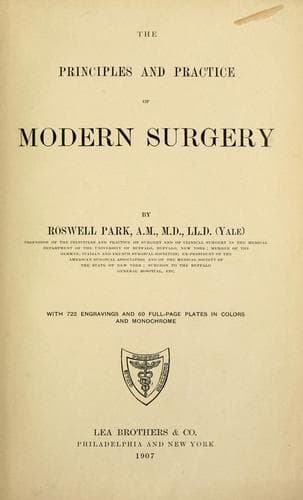
The principles and practice of modern surgeryPark, Roswell
Science
The principles and practice of modern surgery
Park, Roswell
Surgery
=Symptoms.=--The _period of incubation_ in man is variable, ten weeks
being perhaps the average. It is shorter in children, as also when
the bites are numerous. It is even stated that it may be as long as a
year or more, during which time the poison seems to lie latent. When
the active symptoms supervene there are, locally, discomfort about
the wound, itching, heat, and peculiar unpleasant sensations. It is
said also that vesicles may make their appearance in the neighborhood
of the original lesion. _As in animals, so in man_, the disease may
assume either the _furious_ or the _paralytic_ type. These cases are
nearly all marked by mental depression and apathy, with complete
loss of courage. The earlier symptoms are connected perhaps with the
respiration, which is infrequent, while inspiration is halting and
speech is interfered with. The facial appearance is often changed
to one of anxiety, even despair. The muscles of deglutition are
next involved in a combination of spasm and paralysis, and the act
of swallowing is interfered with, sometimes made almost impossible.
Although patients can swallow their own saliva, they find it difficult
to swallow any foreign substances, such as water, etc. This is _not
due to the fear of water_, as the term “hydrophobia” would imply--this
being an absolute misnomer--but is due to reflex spasm excited by
the attempt. It is accompanied by more or less sense of suffocation
and palpitation of the heart. Indeed, a paroxysm of this kind may
be precipitated by the attempt to swallow, so that the patient
instinctively refuses water or any other fluid. _Reflex excitability_
is also very great, and a breath of air or a trifling disturbance may
precipitate a paroxysm, almost as in extreme cases of tetanus. As the
case progresses the saliva becomes more tenacious and viscid, faucial
irritation more marked, and the attempts to expel the secretion, along
with the disturbed respiratory efforts, have given rise to the foolish
lay notion that these patients bark like dogs. The paroxysms, as the
case progresses, become more marked, the patient more restless, until,
later, furious mania or muttering delirium is present, to be followed
by prostration and paralytic phenomena, muscle tremor, etc., and death.
The _paralytic form in man_, as in dogs, is marked by the much
earlier paretic phenomena, anesthesia, and, finally, respiratory
paralysis which terminates the case. Curtis and others have insisted
that the hydrophobic paroxysms are not convulsions in the ordinary
sense of the term, but are due to temporary inhibitions of the most
important respiratory and cardiac centres as the result of peripheral
impressions. He likens them to the shock of a shower bath.
Public-domain text, read in full here on John Shaqi.
Reviews
Reviews
No reviews yet
Be the first to share your thoughts on this work.
Elsewhere in the archive
Join the Discussion
Join the discussion
Sign in to leave a comment or review.
Sign InorCreate an account