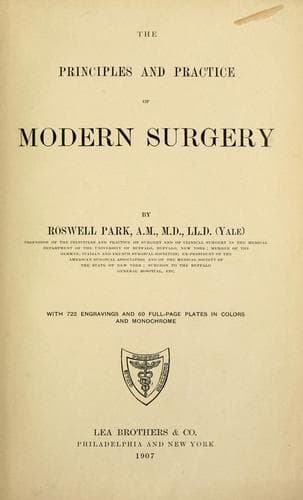
The principles and practice of modern surgeryPark, Roswell
Science
The principles and practice of modern surgery
Park, Roswell
Surgery
=Caseation.=--Caseation comprises a series of changes in the chemical
constitution of the cells by which an albuminoid mass much resembling
casein in composition and appearance is produced. The English
equivalent _cheesy_ well describes many of these masses, which both cut
and appear very much like domestic cheese. They have a yellowish color,
and are met with in masses in size from a pin’s head up to a robin’s
egg. These are the yellow tubercles of the older writers, and such a
cheesy tumor has been called _tyroma_.
=Calcification.=--Calcification refers to a peculiar deposition
of calcium salts within the interior of these nodules, the first
precipitation occurring usually in the centre of the giant cell, which
is itself the topographical centre of the miliary tubercle. It may
spread from this until a mass easily recognizable by the naked eye and
detectable by the finger is produced. Such calcareous particles are
frequently found in sputa, and are always an index of the tuberculous
character of the case. They differ markedly from the yellow calcareous
nodules found in the pus of actinomycosis, the circumstances under
which they are likely to be confused being met in pulmonary disease.
COLD ABSCESSES.
=Suppuration=, as indicated, is the result of a mixed or secondary
infection with pyogenic organisms. In the previous chapter tubercle
bacilli were grouped as among the facultative pyogenic bacteria, yet
pus is not formed in this disease except in consequence of coincident
activity of other bacterial organisms. Suppuration of tuberculous foci
is of importance to the surgeon, because thereby is produced a distinct
class of so-called abscesses--namely, the _cold_ or _congestion
abscesses_. These are of the chronic type, and are generally free from
the ordinary signs of abscess formation. They are invariably the result
of local infection, sometimes perhaps by the tubercle bacilli alone,
but frequently by the combined action of these with pyogenic forms. For
their formation a previous tuberculous lesion is essential. Wherever
old tuberculous lesions are encountered cold abscesses also may form.
No tissue or organ is exempt: they are found in the brain, in the
bones, viscera, joints, skin--in fact, in all parts of the body.
Public-domain text, read in full here on John Shaqi.
Reviews
Reviews
No reviews yet
Be the first to share your thoughts on this work.
Elsewhere in the archive
Join the Discussion
Join the discussion
Sign in to leave a comment or review.
Sign InorCreate an account