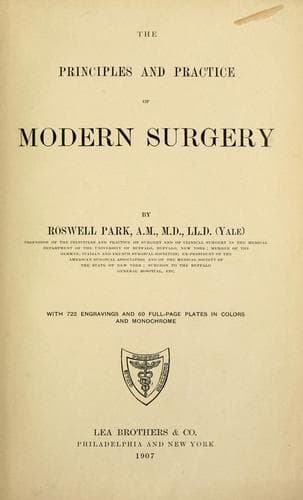
The principles and practice of modern surgeryPark, Roswell
Science
The principles and practice of modern surgery
Park, Roswell
Surgery
This tissue may be met with in any of the tissues of the body, but
is less seen upon the serous membranes of the cranial and peritoneal
cavities, whereas in the joint cavities it is common. It is provoked,
as just stated, by the presence of tubercle, and has the power of
penetration into and substitution for almost all the other tissues
of the body. Thus in a primary tuberculous focus within the bone a
granuloma will form and extend its limits, while the surrounding bony
tissue melts away before it; and it is by the growth of this tissue
in a particular direction that tuberculous products from within the
bone cavity are finally carried to the surface. When this material
has escaped from bone, or from tissues without the bone, toward the
surface its presence is marked by induration, by livid discoloration of
a limited area of skin, with elevation of the surface, which finally
breaks down and shows discolored, bleeding, and pouting granulations,
which in the absence of restraint now proliferate more rapidly, and
often to the point where they loose their former blood supply, and
consequently necrose upon the surface. This is the _fungous granulation
tissue_, especially of the German writers, and may be met with upon
the surface, or is frequently seen in opening into joint cavities and
other tissues infected by tubercle. The appearances of this fungous
tissue are modified somewhat by environment and pressure: in joints
flat and radiating masses of it will be found, extending along the
synovial surfaces and into the articular crevices. This fungous tissue
may grow in any direction, but apparently advances in the direction of
least resistance. It leads to complete perforations of the flat bones,
like those of the skull, while tuberculous masses from the dura may
cause multiple perforations, the granulation tissue finally escaping
through the overlying skin. In tuberculosis of synovial sheaths and
bursæ it extends along and may completely fill and even distend them.
It will separate tissues which were united together, and it may lead
to disintegration and disorganization of the firmest textures in
the body. So long as it is not exposed to the air nor to pyogenic
infection, it will preserve its characteristics for a considerable
length of time. Immediately upon exposure it is likely to break down,
and infection will travel speedily along it into the deeper cavity
whence it has sprung. A mass of this tissue contained within the normal
tissues, condensed more or less by pressure, uninfected, and not freely
supplied with blood, is entitled to the name of _tuberculous gumma_,
whose tendency, however, is too often to break down and suppurate.
Such gummas may be found in any part of the body, and differ only in
unessential respects from the diffuse and more or less infiltrated
masses of granulation tissue which occupy serous cavities or which
extend in various directions.
Public-domain text, read in full here on John Shaqi.
Reviews
Reviews
No reviews yet
Be the first to share your thoughts on this work.
Elsewhere in the archive
Join the Discussion
Join the discussion
Sign in to leave a comment or review.
Sign InorCreate an account