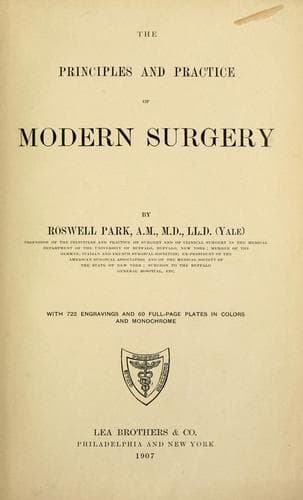
The principles and practice of modern surgeryPark, Roswell
Science
The principles and practice of modern surgery
Park, Roswell
Surgery
_In the lymphatic structures and lymph nodes_ tuberculosis is a most
frequent affection. In these localities it may occasionally be primary,
but is almost always a secondary lesion. It is in separating from the
lymph stream the tubercle bacilli, which would otherwise be passed
into the general circulation, that the lymph nodes, acting as filters,
render us the greatest possible service. These filters themselves,
however, almost always become infected, and, enlarging, they assume
the appearances known to the laity as _scrofula_, which have been
generally referred to as _scrofulous glands_. These lesions abound
rather about the axilla and the cervical and bronchial nodes than about
the lower extremities. Nevertheless, the retroperitoneal, mesenteric,
and inguinal nodes are occasionally infected. In these nodes will be
found giant cells surrounded with epithelioid cells, containing bacilli
and undergoing cheesy degeneration or suppuration. Infection often
proceeds from centre to periphery, and then to the surrounding tissues,
the filter, as such, having become so choked that nothing seems to pass
it. By virtue of this surrounding infiltration (which used to be known
as _peri-adenitis_, when lymph nodes were spoken of as _lymph glands_)
generalized infection is in some measure prevented, while the natural
barriers are altered and natural distinctions between tissues are
lost. This makes complete extirpation of these tuberculous foci often
very difficult, while the adhesions which they contract, for instance
in the neck, are often to the large vessels and nerve sheaths, by all
of which their operative treatment is naturally complicated. When
infection from the superficial nodes extends toward the surface it is
easily recognized by the dusky hue of the overlying skin, the hardness,
infiltration, and, later, the fixation, of these masses, accompanied
usually by evidences of suppuration.
_In and on the serous membranes_ we find tuberculous lesions, either
primary or metastatic, usually miliary in type. In the _pleural cavity_
they produce effusion (hydrothorax), which may necessitate repeated
paracentesis, or by a mixed or secondary infection may cause empyema,
for which much more radical and even extensive operations are demanded.
(See Thoracoplasty.)
In the case of the _peritoneum_ we find (_a_) miliary tuberculosis,
(_b_) a slower non-exudative form with firm, sometimes pigmented
nodules, and (_c_) a form characterized by small gummas which become
caseous, coalesce, and ulcerate, binding together intestinal coils
and producing extensive and irregular adhesions, with seropurulent
exudation, often enclosed in walled-off sacs. In all of these cases
surgical intervention should be considered, while in the more acute
miliary forms abdominal section, with flushing, has in many instances
afforded relief.
Public-domain text, read in full here on John Shaqi.
Reviews
Reviews
No reviews yet
Be the first to share your thoughts on this work.
Elsewhere in the archive
Join the Discussion
Join the discussion
Sign in to leave a comment or review.
Sign InorCreate an account