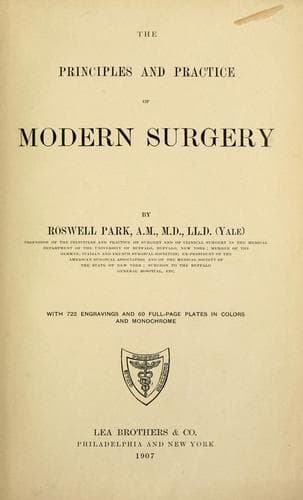
The principles and practice of modern surgeryPark, Roswell
Science
The principles and practice of modern surgery
Park, Roswell
Surgery
palate, by the ulcerative processes so common in this disease.
The joints are subject to changes somewhat similar to those occurring
in tuberculous disease. There may be either a gummatous synovitis
or an arthritis, or else destruction of articular surfaces. These
joint lesions of syphilis are all slow in their course, and sometimes
difficult of distinction from tuberculous and other lesions. They have
so much in common with the joint expressions of tabes that some writers
believe that tabes is necessarily an expression of syphilis of the cord.
As long as no active destruction has occurred within a bone or joint
these cases are usually amenable to treatment, but for the actual
destructions caused here or elsewhere by syphilis there is no repair
possible, and the harm once done cannot be undone. Plastic operations
and injections of paraffin may have to be practised for cosmetic
purposes and relief of disfigurement.
=Muscles and Tendons.=--It is the connective tissue of muscles which
suffers most in the luetic affection of these structures. It may be
met with as a diffuse process or as a gumma. In the former cases the
muscle becomes irregular in shape and size, and in the latter distinct
tumors are formed. As such growths advance and contract adhesions to
surrounding structures, there is interference with muscle play.
_Syphilitic myositis_ causes little pain, and patients with gummas in
muscles are often not seen until ulceration has begun.
The dense fibrous structure of _tendons_ and _aponeuroses_ is
frequently involved in late syphilis, causing pain and disability.
Little is discovered on physical examination, but considerable loss of
function may result. Points of tenderness sometimes are noted along
junctions with the adjoining periosteum. Such a _tendoperiostitis_ may
be painful, and even crippling.
=Bursæ.=--Bursæ are prone to be involved in syphilis, especially those
in front of the patella. A gumma frequently develops at this point,
where it constitutes a painless, somewhat tender enlargement, which
may be dense or elastic. After it has become adherent to the skin it
is usually infected, and a chronic ulcer results at this point, which
may often manifest gangrenous tendencies. This constitutes one form of
so-called _housemaid’s knee_.
Public-domain text, read in full here on John Shaqi.
Reviews
Reviews
No reviews yet
Be the first to share your thoughts on this work.
Elsewhere in the archive
Join the Discussion
Join the discussion
Sign in to leave a comment or review.
Sign InorCreate an account