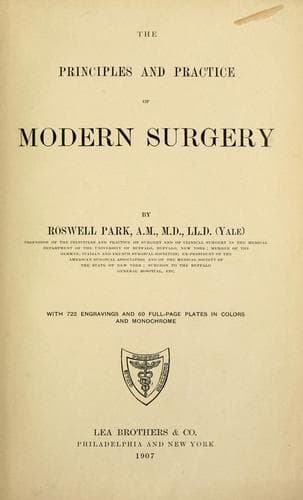
The principles and practice of modern surgeryPark, Roswell
Science
The principles and practice of modern surgery
Park, Roswell
Surgery
=Profeta’s “Law.”=--Profeta first made the statement that the child of
an infected mother who acquired the disease late in her pregnancy may
not only be born healthy, but may be immune to subsequent infection,
as are other healthy children of syphilitic parents. But, on the other
hand, such a child may be anemic, puny, with small resisting power, or
it may develop a late hereditary syphilis. When the ovum is infected
by the father the healthy mother may escape, or she may acquire the
disease through the placenta in her own uterus, or she may suffer from
a mitigated form of syphilis whose principal features will appear as
late manifestations of the disease.
=Colles’ “Law.”=--Colles, in 1837, made the statement that such a
mother may remain healthy with an acquired immunity to subsequent
infection. The statements above made have often been alluded to as
Profeta’s and Colles’ “laws.” These should, however, be regarded simply
as statements of what usually occurs, and too much dependence should
not be placed upon them. In fact, the immunity which the mother or the
child may enjoy under conditions mentioned above is not likely to be
permanent, though it may last for a varying period of time. There is
no limit to the time when a parent may transmit syphilis to the child.
The five-year limit given for the father is often overstepped, and the
longer the man waits before marrying after acquiring the disease, and
the more thoroughly he submits to judicious treatment, the less likely
he is to convey it to offspring. This is the strongest kind of argument
that can be used to _delay marriage of syphilitics_.
_The indication of syphilis on the part of the mother_ is, in addition
to those already given above, a tendency to miscarriage or abortion.
The earlier she acquires the disease the earlier will the mishap occur.
Should she escape the child may go on to full term, or it may die and
be expelled as a dead fetus two or three months before the expiration
of term. Should a child be born alive with hereditary syphilis, the
evidences may appear at birth or within three months. Should a child
apparently escape for six months it may grow up to be puny or develop
some form of late hereditary disease, or it may possibly remain well.
These children usually show developmental defect in some direction, and
manifest a much weakened resisting power to other diseases; moreover,
the spleen will usually be found enlarged.
Public-domain text, read in full here on John Shaqi.
Reviews
Reviews
No reviews yet
Be the first to share your thoughts on this work.
Elsewhere in the archive
Join the Discussion
Join the discussion
Sign in to leave a comment or review.
Sign InorCreate an account