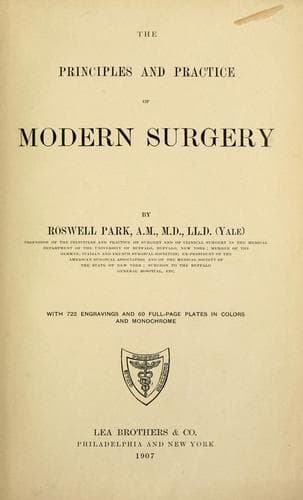
The principles and practice of modern surgeryPark, Roswell
Science
The principles and practice of modern surgery
Park, Roswell
Surgery
Urethritis and cystitis may be treated as when they occur in the
male. There is the same liability in women as in men to lymphatic
involvement, with the consequent bubo, which may perhaps suppurate.
They are less liable to the widespread manifestations of postgonorrheal
infections of the joints, etc., although they are even more liable
to infection of the endocardium, and, as will be readily understood,
more so to infection of the peritoneum. It will then be seen that the
treatment of the disease is essentially the same in either sex, certain
differences in method rather than in principle having to be made in
accordance with anatomical requirements.
As to the rectal mucous membrane participating in gonorrheal infection,
under ordinary circumstances it would escape. In the treatment of any
of these cases by the sitz bath, the question might arise whether there
would be danger of extending the contagion in this direction. It does
not appear that much fear need be felt, for two reasons: the grasp
of the sphincter is usually sufficient to prevent entrance of fluid,
and, furthermore, the rectal mucosa is itself extremely resistant to
the gonococcus. _Gonorrheal proctitis_ is an exceedingly uncommon
infection, and one rarely seen, except in extreme cases of sexual
perversion. It should be treated in about the same manner as gonorrheal
vaginitis, _i. e._, by continuous irrigation with hot water, and
stretching the sphincter in order to overcome the spasm into which it
would be thrown by reflex activity.
_Gonorrheal urethritis_ in women is best treated with local
applications of argyrol or one of the other silver compounds. These
can be made with a syringe or with a small swab. _Cystitis_ is to be
treated in the same manner as when it occurs in the male.
CHAPTER XIII.
SCURVY AND RICKETS.
SCURVY.
Scurvy is placed among the so-called surgical diseases, since it
manifests many distinctly surgical features and is possibly of
parasitic character, although this feature of its existence has not
been incontrovertibly established. It is a _starvation_ disease, its
principal characteristic being that of _malassimilation_, accompanied
by profound _anemia_. Well-marked cases are seen during long sieges,
like that of Paris, in 1871, or during long imprisonment, as in
Andersonville prison. It has certain points of resemblance to that
condition of multiple neuritis met with in warm climates, and known
usually as _beriberi_. The former is apparently due to the absence of
a vegetable regimen, while beriberi is largely due to the absence of
an animal regimen, nature having intended that man’s diet should be
mixed, and having ordained that suffering and disease always follow
confinement to one or the other.
Public-domain text, read in full here on John Shaqi.
Reviews
Reviews
No reviews yet
Be the first to share your thoughts on this work.
Elsewhere in the archive
Join the Discussion
Join the discussion
Sign in to leave a comment or review.
Sign InorCreate an account