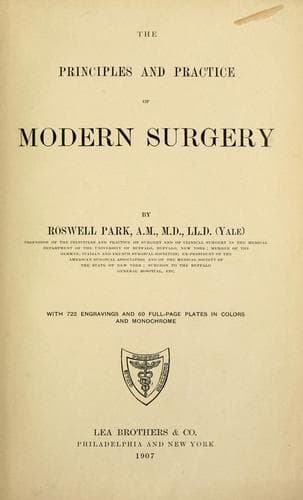
The principles and practice of modern surgeryPark, Roswell
Science
The principles and practice of modern surgery
Park, Roswell
Surgery
The modern opotherapy of rickets includes the employment of _thyroid_
and _pituitary extracts_. The dose should be graduated to the age of
the patient, based upon 30 Cg. for an adult, and given thrice daily.
This will not preclude the necessity for a careful regulation of diet,
etc., but will constitute a valuable adjunct in treatment.
The deformities due to rickets are so numerous as to constitute a large
part of those to which special or orthopedic surgery is addressed. The
mechanical and operative treatment of these cases will be referred to
in their appropriate place.
CHAPTER XIV.
THE STATUS LYMPHATICUS.
Under the term _status lymphaticus_ has been described a condition
which is of interest to the surgeon, as it includes not only minor
complications, and even those which are serious, which follow surgical
procedure, but it also has reference to the cases of sudden death
during or after operation, some of which have been attributed to the
anesthetic, while others have been considered absolutely unexplainable.
The condition is so easily described or defined that it should be
recognized during life, but it has often been discovered only after
sudden death.
The essential feature of the condition is _enlargement of the
lymphatic tissue and apparatus_, perhaps throughout the entire body,
more frequently through its internal portions. It usually occurs
in children. It is accompanied by much lowering of the power of
resistance, and results in sudden death from cardiac failure, as
the result of causes which seem disproportionately trivial; as, for
instance, such deaths as occur not merely during anesthesia, but during
bathing, convalescence from the exanthemas, etc. It stands in close
relation to diphtheria, perhaps because of its peculiarly depressing
toxins, and probably accounts for cases of sudden demise in that
disease, even when mild.
The status lymphaticus is also designated by other names, as
_lymphatism_, _lymphatic constitution_, and _status thymicus_, the
latter because of the active participation of the thymus. Enlargement
of this body has been noted at autopsy, but its relation to the other
features of status lymphaticus were unknown until Rokitansky, in 1842,
first recognized the condition in its entirety, but confused it with
the tuberculosis of the lymphatics formerly called scrofula.
Public-domain text, read in full here on John Shaqi.
Reviews
Reviews
No reviews yet
Be the first to share your thoughts on this work.
Elsewhere in the archive
Join the Discussion
Join the discussion
Sign in to leave a comment or review.
Sign InorCreate an account