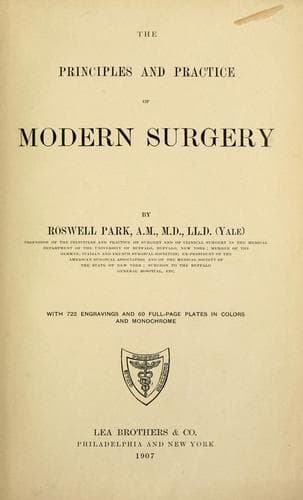
The principles and practice of modern surgeryPark, Roswell
Science
The principles and practice of modern surgery
Park, Roswell
Surgery
The _arrow poison_ of various Indian and savage tribes is a composition
of variable and usually unknown nature. It is compounded, for the
most part, from vegetable substances, and, if one may judge from the
specimens of _curare_ sold by importing houses, their strength is
unreliable.
While some of these preparations are made by the natives from a species
of Strychnos growing in the northern part of South America, this tree
is not in universal use for this purpose: in the East Indies they are
made from a species of Upas (the deadly Upas of song and story). Some
of the poisoned arrows are dipped in putrefying blood. A wound made
by these is not necessarily promptly fatal, but would tend to kill by
setting up septic disturbance. The vegetable poisons have the property
of paralyzing the motor nerves and the circulation to such an extent
that death may occur within a few moments after injury. All of these
poisons are innocuous when swallowed, and game killed by their agency
may be eaten without fear of ill results. Arrow poison of the vegetable
variety which is not fatal within a few hours may be recovered from if
stimulation be vigorous. Artificial respiration is a factor in keeping
such patients alive.
IVY POISONING.
_In the vegetable kingdom_ there is one kind of plant, the so-called
_poison ivy_ (_Rhus toxicodendron_), which is capable of producing
intense dermatitis. All persons are not susceptible to this
poison--least so those of thick skin and dark hair. It is generally
those of blonde type and thin skin who seem most liable to its
irritation.
The active agent is _toxicodendric acid_, and it is capable of setting
up an intense irritation of the eczematous type, with a large amount
of hyperemia and edema, especially of soft tissues. When the face is
involved the eyelids become puffed so as to make it almost impossible
to separate them for purposes of vision. _Ivy poisoning_ is usually
contracted by contact with the plant. Symptoms supervene generally
within twenty-four hours, and in well-marked cases do not subside for
three or four days. The itching is intolerable, and is best combated by
strong alkaline solutions or brine. A dilute bromine solution sometimes
proves beneficial. Salt and soda in strong solution and vigorous
catharsis are also useful. Hypodermic injections may be necessary to
induce sleep.
Certain species of _sumach_, particularly the genus Cypripedium, may
produce similar symptoms, usually less severe.
CHAPTER XVII.
ACUTE INTOXICATIONS, INCLUDING DELIRIUM TREMENS.
DELIRIUM TREMENS.
Public-domain text, read in full here on John Shaqi.
Reviews
Reviews
No reviews yet
Be the first to share your thoughts on this work.
Elsewhere in the archive
Join the Discussion
Join the discussion
Sign in to leave a comment or review.
Sign InorCreate an account