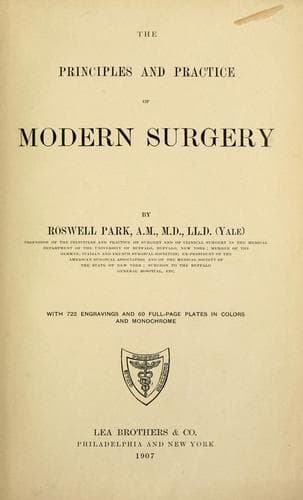
The principles and practice of modern surgeryPark, Roswell
Science
The principles and practice of modern surgery
Park, Roswell
Surgery
Of the less active antiseptic agents, _boric acid_ is considered
absolutely innocuous, yet is known sometimes to cause intestinal
disturbance, while in one instance serious toxic effects followed its
use. _Naphthalin_ will sometimes produce vertigo or vasomotor symptoms,
especially when administered internally. Many of the antiseptic
materials used are more or less irritating to the skin, and such local
expressions as _eczema_, etc., provoke little comment.
_Iodine_ is a drug whose activity should be borne in mind. Applied
upon the surface, it tans the skin and does no good. Injected in
solutions of varying strength into serous cavities (for example,
hydroceles, etc.) it gives rise to symptoms which may be alarming.
Fatal poisoning following its injection into an ovarian cyst has been
reported, and alarming symptoms have been produced by injection of the
ordinary solution into a hydrocele sac. Much of the virtue ascribed
to _iodoform_ is credited to the liberation of free iodine by its
decomposition. Whether or not this be true, iodoform is one of the
most frequently toxic of the antiseptic agents in ordinary use. In
mild cases it produces headache, restlessness, wakefulness, and often
a distinct taste of iodoform in the mouth. In more pronounced degrees
of poisoning there is fever, often with mental derangement which may
amount to delirium or even to acute mania, and may cause well-founded
suspicion of meningitis. Death after its use has repeatedly occurred
from syncope or in coma.
_Carbolic acid_ produces unpleasant effects, both upon patient and
operator, or with whoever it may come in contact. Aside from its local
effect upon the skin, which is most unpleasant, but which usually
passes away within a few hours, it seems to affect especially the
kidneys, causing often temporary albuminuria with discolored urine,
deranged secretion, and sometimes more acute forms of disturbance,
similar to those met with after its internal use. Carbolic poisoning
was observed most frequently during the era when Lister’s original
directions were scrupulously followed, and at a time before it was
learned that it is much better to remove dirt than to try to antagonize
its action. Eminent surgeons were compelled to discontinue its use
because of its unpleasant effect upon themselves as well as upon their
patients.
Public-domain text, read in full here on John Shaqi.
Reviews
Reviews
No reviews yet
Be the first to share your thoughts on this work.
Elsewhere in the archive
Join the Discussion
Join the discussion
Sign in to leave a comment or review.
Sign InorCreate an account