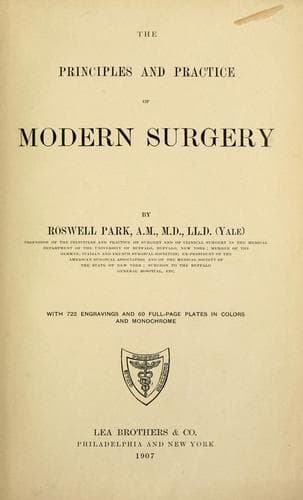
The principles and practice of modern surgeryPark, Roswell
Science
The principles and practice of modern surgery
Park, Roswell
Surgery
=Treatment.=--The treatment of shock consists essentially in measures
directed toward raising the lowered blood pressure. At the outset
reaction should not be established too quickly, lest it be succeeded
by overaction, with attendant disasters in the shape of secondary
hemorrhage, etc. Patients should not be expected to swallow nor act
as they would under other circumstances. They should not drink strong
liquors, for the irritating fluid may escape into the larynx and induce
coughing, which might prove fatal. The same is true of inhalations of
strong volatile stimulants, like ammonia. These measures, therefore,
should all be resorted to with great care and discretion. Warm,
stimulating drinks, if they can be swallowed, are useful; and whisky,
brandy, etc., should be given dilute and warm rather than strong and
cold. External heat is advisable, and can be supplied by immersing
the patient in a bath-tub of warm water, care being taken to keep the
face out of the water. When this is not at hand, bottles and other
receptacles for warm water may be used, but with caution, since too
much heat has been the cause of serious burns.
Numerous drugs have been recommended in the treatment of shock.
There are but two or three which are worthy of confidence. Crile, of
Cleveland, subjected a large number of animals to tests in regard to
the effect of various drugs in influencing blood pressure. He found,
for example, that alcohol apparently produces more depression, and
in deep shock is dangerous. Nitroglycerin and amyl nitrite seem to
increase shock and lower pressure. Digitalis may produce a temporary
rise in pressure, but in considerable doses impairs or arrests
respiration, and it seemed to him that cases of severe shock treated
with it did not live as long as the control animals. Strychnine has
been one of the main reliances in these conditions. Crile found that if
enough were given to cause increased excitability of the spinal cord it
raised the blood pressure, while small doses had little or no effect.
Pressure was raised by doses large enough to produce convulsions;
repeated smaller doses had little effect, tending rather to increase
shock.
These were the experimental results in the treatment of shock, and are
to be distinguished from what may be done with the same drugs in the
way of fortification and preparation as against shock. Thus strychnine
always exalts susceptibility of the cord of the medulla and digitalis
may temporarily supplement its use; together they may help to sustain
pressure or to fortify as against depressing agencies. They are like
whip or spur to a jaded horse.
Public-domain text, read in full here on John Shaqi.
Reviews
Reviews
No reviews yet
Be the first to share your thoughts on this work.
Elsewhere in the archive
Join the Discussion
Join the discussion
Sign in to leave a comment or review.
Sign InorCreate an account