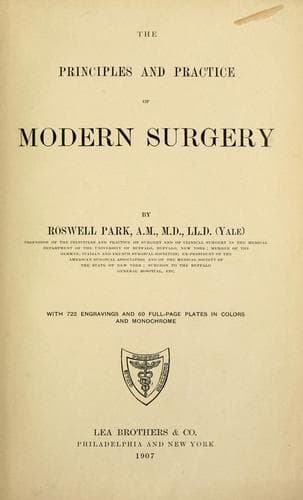
The principles and practice of modern surgeryPark, Roswell
Science
The principles and practice of modern surgery
Park, Roswell
Surgery
Bacteria which act as agents in the formation of pus are collectively
known as pyogenic organisms. These are divided into two groups:
A. _The Obligate_; and
B. _The Facultative._
_Obligate_ pyogenic organisms are those whose activity is manifested
in the direction of pus formation, which seem to produce it if they
produce any unpleasant action whatever. On the other hand, the
_facultative_ organisms are those which are known occasionally to be
active in this direction, and yet which are not always nor necessarily
so. The members of group A are fairly well known and catalogued, and
are not numerous. On the other hand, there is reason to believe that
many organisms may have the occasional effect of producing pus, as
it were, by accident or at least in a way not absolutely natural or
peculiar to themselves, but still are frequently found when there is no
pus present. A suitable list of the facultative organisms, therefore,
can hardly be made, and will not be here attempted, the effort being
only to mention the more common organisms which play this facultative
role. It may be mentioned also that even the adjectives “obligate” and
“facultative” are to be accepted with some mental reservation, since
staphylococci, for instance, may be met with even in the absence of
pus, although nearly all that we know about these organisms implies
that pus would be the result of their presence. Furthermore, there are
certain other organisms, not, strictly speaking, bacteria, which also
have the power of producing either pus or pyoid material. These also
will be mentioned in their place. Some of them belong not only to the
vegetable, but also to the animal kingdom.
=Obligate Pyogenic Organisms.=
A. =The Staphylococcus Pyogenes Aureus, Albus, Citreus, the
Staphylococcus Epidermidis, etc.=--One of the characteristics of the
staphylococci as a group is the powerful peptonizing action which they
exert. Moreover, the chemical products of their life changes seem
to be more potent in a local than a general way, leading to greater
destruction of tissue in their immediate vicinity, with greater
inhibition of the chemotactic powers of the leukocytes; that is, with
more interference with phagocytosis, by which their progress would
be interfered with. Their presence is recognized by a peculiar odor,
as of sour paste, which should lead to a prompt change of dressings
and disinfection of the wound (by irrigation, spraying with hydrogen
dioxide, etc.).
Public-domain text, read in full here on John Shaqi.
Reviews
Reviews
No reviews yet
Be the first to share your thoughts on this work.
Elsewhere in the archive
Join the Discussion
Join the discussion
Sign in to leave a comment or review.
Sign InorCreate an account