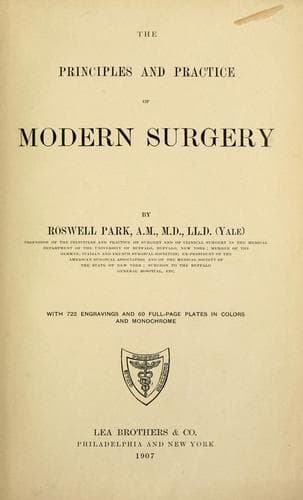
The principles and practice of modern surgeryPark, Roswell
Science
The principles and practice of modern surgery
Park, Roswell
Surgery
The _most effective method_, therefore, in
dealing _with old and chronic ulcers_ is to anesthetize the patient, to
_excise the entire affected area_--_i. e._, the surface which ought to
be granulating and the firm border and tissue in its neighborhood--and
then to cover the surface either with _skin grafts_, pared off with a
razor according to the Thiersch method, or with a strip of skin whose
full thickness is raised, which is taken from surrounding parts by
some autoplastic or heteroplastic method. This line of treatment is so
far preferable to all others that, except in case of refusal of the
patient to submit to it, it is the one which must hereafter commend
itself. It may afford opportunity for extensive plastic operations or
for the exercise of the best discretion and knowledge of experienced
men; yet cases are rare in which it cannot be successfully performed.
These methods of skin grafting have so far supplanted the older method
of sponge grafting that the latter is now seldom practised. It may
possibly have a sphere of usefulness in certain ulcerated cavities, but
under all other circumstances it must take a position far below the
plastic methods in practical value.
Finally, ulcers of specific type--syphilitic, tuberculous, leprous,
glanderous, etc.--need methods in which the first effort should be not
so much to arrange for healing as to dispose of infectious material.
The knife, the scissors, the sharp spoon come first into use here,
the surgeon bearing in mind that almost all this material is more or
less infectious, and that inoculation of his own hands is possible as
the result of carelessness. After taking away with instruments all
the granulation tissue, with its surroundings, which seems to expose
to danger, it is well to cauterize the part with the actual cautery,
nitric acid, bromine, or zinc chloride.
The markedly _hemorrhagic ulcer_, whose surface bleeds on the
slightest contact or disturbance, is often a cancerous ulcer, though
not necessarily so. This ready bleeding is usually the effect of
the fragility of the walls of the new-formed bloodvessels. In many
instances it is sufficient to scrape until harder or more resisting
tissue is encountered. Hemorrhage may be profuse for the moment, but it
is easily controlled. Caustics may then be applied or not, according to
the judgment of the surgeon.
Another method is to treat such a surface with the actual cautery.
Another is to operate, even in the presence of incurable disease, in
order to check a tendency to fatal hemorrhage before the disease has
expended itself. In a general way, in regard to small, ulcerating,
cancerous surfaces, it may be said that if they bleed excessively or
are unduly irritable, it is preferable to attack them by operative
measures in spite of the impossibility of effecting a cure.
There are other methods of treating ulcers, but they have mainly been
abandoned for those mentioned.
CHAPTER V.
GANGRENE.
Public-domain text, read in full here on John Shaqi.
Reviews
Reviews
No reviews yet
Be the first to share your thoughts on this work.
Elsewhere in the archive
Join the Discussion
Join the discussion
Sign in to leave a comment or review.
Sign InorCreate an account