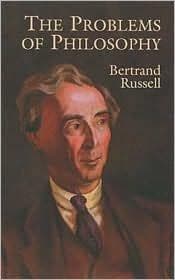
Knowledge, Theory of; Metaphysics; Philosophy -- Introductions
If the above account is correct, all our knowledge of truths depends
upon our intuitive knowledge. It therefore becomes important to consider
the nature and scope of intuitive knowledge, in much the same way as,
at an earlier stage, we considered the nature and scope of knowledge by
acquaintance. But knowledge of truths raises a further problem, which
does not arise in regard to knowledge of things, namely the problem of
_error_. Some of our beliefs turn out to be erroneous, and therefore
it becomes necessary to consider how, if at all, we can distinguish
knowledge from error. This problem does not arise with regard
to knowledge by acquaintance, for, whatever may be the object of
acquaintance, even in dreams and hallucinations, there is no error
involved so long as we do not go beyond the immediate object: error can
only arise when we regard the immediate object, i.e. the sense-datum,
as the mark of some physical object. Thus the problems connected
with knowledge of truths are more difficult than those connected
with knowledge of things. As the first of the problems connected
with knowledge of truths, let us examine the nature and scope of our
intuitive judgements.
CHAPTER XI. ON INTUITIVE KNOWLEDGE
There is a common impression that everything that we believe ought to be
capable of proof, or at least of being shown to be highly probable. It
is felt by many that a belief for which no reason can be given is an
unreasonable belief. In the main, this view is just. Almost all our
common beliefs are either inferred, or capable of being inferred, from
other beliefs which may be regarded as giving the reason for them. As a
rule, the reason has been forgotten, or has even never been consciously
present to our minds. Few of us ever ask ourselves, for example, what
reason there is to suppose the food we are just going to eat will not
turn out to be poison. Yet we feel, when challenged, that a perfectly
good reason could be found, even if we are not ready with it at the
moment. And in this belief we are usually justified.
Public-domain text, read in full here on John Shaqi.
Reviews
Reviews
No reviews yet
Be the first to share your thoughts on this work.
Join the Discussion
Join the discussion
Sign in to leave a comment or review.
Sign InorCreate an account